SUN PRINTS - AND AN UPCOMING ARTIST RESIDENCY

Delighted to announce I will be taking part in a week-long artist residency at the end of July through the Dumoine River Art for Wilderness Retreat, sponsored by the Canadian Parks and Wilderness Ottawa Valley Chapter. The retreat includes 15 or so artists using a variety of mediums from felting to photography to painting to storytelling. We will be creating art en plein air, inspired by the rugged beauty of the area.

The goals of the retreat are to:

  • learn more about conservation, to be inspired by the richness of the area
  • create art that supports CPAWS-OV's conservation work, and
  • raise awareness of the important of parks and protected areas in halting and reversing climate change and biodiversity loss. 

My personal goals at this residency are to:

  • create small fibre art pieces to document parts of the landscape: the lines in nature, decay, tree bark, lichen, rocks, and more 
    • I also plan to do some sketching and take oodles of reference photos to continue this goal later on, plus record my impressions about the land, colours, textures and other thoughts, and 
  • experiment with sun printing on fabric and paper. We won't have electricity at this retreat, so steaming my fabric to eco print won't be an option. Instead I'll use the power of the sun. 

In preparation for sun printing at the retreat, I googled this topic looking for information such as which paints and materials work best, since I can bring only a limited amount of supplies. I found only a handful of blogs where the writers have experimented beyond the basics. Cotton fabric was highly recommended, and 2 types of paints: Pebeo setacolor for light fabrics (a transparent paint) and Liquitex soft body acrylics. Some also recommended using mordants such as alum or rust. 

Here is what I have tried so far as I began experimenting prior to the retreat start:

  • White cotton and cotton rag paper: I treated both with alum in advance, then painted  with Setacolor paints. The fern leaves have good contact with the paper and fabric, helping to ensure sharper edges in the final print. I left these to dry for about 2 hours. 


Below is the result on the cotton fabric - this was on an old, embroidered cloth:


This was the result on cotton rag paper, much more subtle, yet I do quite like the effect:


  • Next I tried a scrap from an old yellow cotton sheet, putting it into a rust mordant first, then painting it with the Liquitex soft body acrylics. I  am very very pleased with the result:

  • Old linen, treated first in a rust mordant, turned out beautifully using red and orange Liquitex paints:


  • Rice paper, painted with the Liquitex soft body paints. I had no idea how this would turn out. It's subtle, yet soft looking, and I think has wonderful potential as a background or perhaps with some stitching added: 


  • Yupo paper was next on my list to try, and is my favourite so far. Yupo is a synthetic paper, very smooth, and often painted with alcohol inks. For this experiment, I tried Setacolor paint, with surprisingly pleasing results. I love that the veins of the leaf show up, and that the print left a solid line around the leaves. I will definitely experiment with more on this paper and already have a project idea in mind:


  • These next two are on watercolour paper using Setacolor paints, also with interesting effects. I'll be trying this again to see if I get similar results:


So, what's next? 

I've had fun with these experiments - and will try different leaf and plant types to see which will provide good contact with the materials. I also plan to try bleeding tissue paper and printing  on materials such as mineral paper (made from rocks), Tyvek, brown paper bag, old newspaper, and more. I will let you know how they turn out in the next couple of weeks, as I narrow down my supply list for the retreat. I may even try some solar dyeing in mason jars. 
Out of interest, I found a reference to an article in Quilting Arts Magazine, summer 2006, about sun prints on tissue paper. And I just happen to have that issue in my magazine stash.
Stay tuned!

FINDING INSPIRATION FOR ART

It's been wonderful being able to visit art shows again in person, to actually see the art and not just on a computer screen, to talk to the artists. I like to take photos of art too (with permission of course), especially when I'm inspired by a piece, or when there is a colour combination or perhaps a technique that could be a potential solution to a struggle or two with art that I'm currently making. 

A couple of these shows took me to small towns not far from home. We like to take long walks around places we visit, poking in shops in downtown areas, visiting waterfronts, finding interesting details on buildings and even alleys that invite one to explore. I find so much inspiration and can't help but take more photos, all becoming great references for future. Here are a few from a recent trip that will more than likely be turned into some kind of art:

The striking colour of the orange lichen against
the dark colour, rust, 
and discoloration on a steel bridge:


An old, abandoned factory - there is a kind of beauty in this decay, and I'm already planning a piece from these photos:


I just had to get these 2 photos - a quote painted on a wall on the main street, and a mural made entirely of handpainted small squares, each with a different picture, then assembled into the the larger mural. How inspiring - and creative - are these:


I'm also finding much inspiration during nature hikes. I had joined a snowshoeing and hiking group this past winter, discovering trails in my area that I had not visited before and some I had but had not thoroughly explored. And while I joined primarily for the exercise, I'm thoroughly enjoying the social side and being inspired by the beauty around us during these nature treks, I take photos when I can during these hikes, and have even revisited a couple of places to take more as these photos are providing wonderful inspiration for new art pieces. 

Where do you find your inspiration for new art, or for other creative ventures?


FINDING NATURE'S ARTISTRY - AND WEIRDNESS

I'd never heard of a derecho thunderstorm until last week when one hit this part of the country. 110+ km/hour winds gave way to hundreds of toppled and broken trees in my area. So many old and beautiful trees lost, including 8 on our property. We were among the lucky ones who had very little damage to our house and were without power for only 4 days. We did have to bring in a team to finish taking down broken trees, and spent hours cutting up and clearing branches around our house and the neighboring homes.

While taking photos to document the damage and destruction, I started to notice some of the artistry - and weirdness - of nature in the piles of wood and branches. I decided to try to capture some of this artistry as part of this record, perhaps to interpret into fibre art in future as a further reminder of the destruction - and the beauty revealed - from such a powerful storm.

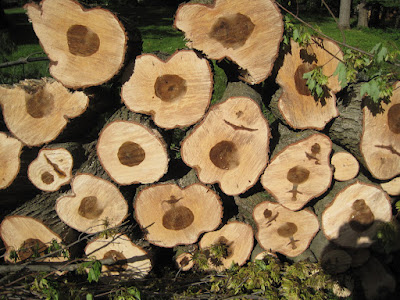
Pile of wood awaiting removal


Lichen covered branch - can you spot the three different types?


Do you see a knot - or an eye?


I took this photo because of the lines in this broken tree stump -
and didn't notice until afterwards the photobombing bee!


I'm pretty sure this is Slime Mold - one of the weirdos of the forest. Although I had heard of it, I don't think I had ever seen it - until now. Like a blob, wet looking, a wee bit gross in fact, yet fascinating all the same. Not sure it will be part of any future art piece though. 


It definitely pays to keep one's eyes open - the more you look, the more you see, and learn.
Respect for nature, respect for storms, and a definite high respect for all the hydro workers, workers clearing trees and branches, volunteers, neighbours helping neighbours during these difficult days. 

CONVERSATIONS - AN UPCOMING GROUP SHOW

Fibre 15, a local fibre arts group I am part of, is preparing for an upcoming gallery show - we've called it Conversations, and described as:


What is a conversation?
Employing a diversity of fibre media, Fibre15 members explore this theme, challenging assumptions about how and what we exchange.


There are 10 of us in this group show being held June 4-26, 2022, with the vernissage on Friday, June 3rd from 6-8 pm, at the Stone School Gallery run by Art Pontiac, at 28 Rue Mill, Portage-du-Fort, Quebec. The gallery is open Thursdays through Sundays from 11 am to 4 pm.

The support from the gallery has been superb as we get ready for this show. Even though I have an events management background, I'm always surprised just how much work and detail shows such as this can take: 

  • agreeing on the theme
  • preparing the proposal and photographs for our application 
  • taking photos of works for the poster (poster was made by the gallery)
  • deciding who brings what food for the vernissage
  • organizing who will work at the gallery which day
  • writing and collecting artist statements and bios
  • preparing price tags and labels for all the art
  • promotion - through social media, video, etc. - and collecting photos and words for this purpose
  • preparation for set-up, and take-down - and who will collect and deliver the works to the gallery - and the set-up day

Of course, someone really needs to be the lead on this whole effort, to ensure no tasks are overlooked, communicating with the gallery, getting answers to questions.

All this while we still had to find time to make our art. That, after all, is what the show is about - our art and the theme.

I have six works ready (4 are pictured below), but am not yet sure which of the six will actually be in the show. A curating team has been assembled who will make the final decisions around space, cohesiveness etc. 


And three of us also applied to teach during this show - I will be teaching collage & embroidery on paper. Here is the same piece - there is more information on the Art Pontiac website at https://artpontiac.com/en/category/course-2022/

Hope to see you at the show!


12 OBJECTIVES WHEN PARTICIPATING IN ART OR VENDOR SHOWS


I first published in this post in September 2018, then again in March 2019. After two years of Covid-19 and with some shows opening up again, this seems like a good time to re-post. While many shows have gone virtual and some are still virtual, most of the objectives listed below still apply. 


Let's talk about goals & objectives for participating in vendor, craft & art shows. Of course making sales is usually the goal in such shows. We have, after all, spent time planning, gathering supplies, making our products, and we've likely paid a fee to be in the event. We want to move some of our products and make some money from it.

But what if you don't reach your sales goal? And worse, what if you don't make any sales or even sell enough to cover your booth fee? It's happened to all of us at one time or another. Frustrating isn't it! And it's easy to become a grumpy cat during the show, but then potential customers don't want to approach us. And sadly we can start to appear desperate.


But, wait! There are many other benefits to participating in a show. A simple shift can make all the difference in your perception of success, even when your sales goal is not reached. And that shift is to be open to the many other positive gains we can make, positives that can help us down the road. And that shift is to look at the event, not just to make sales, but as an advertising opportunity. So bear this and the 12 ideas below in mind when you're at a show, perhaps even set some additional objectives when working at shows. Great sales or not, these are areas we should be looking at anyway to help us in future. 


        Connect with your visitors

  1. Get your name out there - talk to visitors, make an impact so they will remember you. Connect with them. Shows are, after all, an opportunity to advertise and not just sell. They may not have met you or seen your work before. Or perhaps they are just not yet ready to buy and need more time. And once a potential customer has seen your work, they may look for you at other shows or at the same show next year. 
  2. Grow your client base. Do you send out a newsletter, have a blog, Facebook or Instagram account? Capture names and emails to bring people to your social media accounts (always respecting spam laws of course).
  3. Find out what people think about your work and products. This is a perfect opportunity to get feedback. Show visitors who are attracted to your work will tell you what they like about it, what they look for. You can get a feel if people are looking for functional items, are re-decorating, want inspiration and information, are interested in taking workshops, or are at the show for other reasons. Which item draws them in the most, which one is no one looking at? 
  4. Practice your elevator pitch. Hopefully you will have practiced in advance what to say, and the more you can practice, the easier your words will flow. But don't automatically assume someone wants to hear all about your product if they approach your booth. You need to know what to ask to determine what they may be interested in.
  5. Sign people up for workshops - if you teach, a show is a great opportunity to show what you will be teaching, and get people to sign up to learn the techniques you use.
  6. Try demos. Artists often sit and sketch or paint during quiet times. If you sell kitchenware, demo how to use them. Visitors love to watch and it can help draw them in. Check first that show rules allow demos, as some do not. 

    Network with other sellers
  7. Visit the other artists and vendors, see and talk to them about their work. I often find new ideas  - a different way to display something for example - or am simply inspired and motivated by the artist and their work.
  8. Get leads on other shows and opportunities. Lots of networking can happen at shows, and I've been able to not only book other shows but offer spots to others in shows that I have run. 
  9. Get to know the show organizers to see what else they are involved in.

    Test a booth layout
  10. Test a booth layout or new look or colour. Sometimes it takes a bit of trial and error before we happen upon the ideal set-up to show off our work. And a spot in the middle of the room has to be arranged differently than a corner booth. See what others do that may work for you. Sometimes it's just a little pedestal or some height that can make the difference. And testing outdoor booths is important too, in case of rain or wind.
  11. Take photos of your booth - you'll notice things in the photos that you didn't see in real life, both displays that look great and areas that need to be tweaked. Pictures close-up and farther away can be very telling and can go a long way to helping your booth look polished and professional. 

    Be Inspired
  12. Above all, enjoy. If sales are low, don't be the picture of doom. Visitors can feel your negativity, and may be reluctant to approach you. So no matter how things are going, smile, enjoy and be welcoming. And remember the other ideas above. Who knows what the future holds.
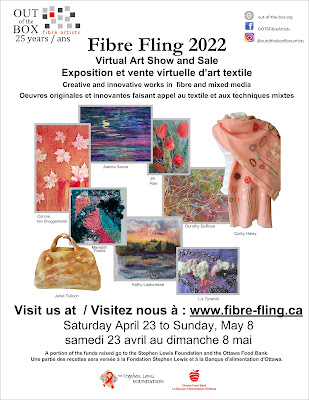
And speaking of virtual, Out of the Box Fibre Artists, of which I am a member, is holding a virtual show & sale April 23, 2022 until May 8th, 2022. Do please check it out! https://fiber-fling.ca/


ALL IN THE FAMILY? COULD OUR INTERESTS BE GENETIC?

Growing up, I wanted to be an architect or interior designer. I signed up for architectural drafting classes in high school, and while I enjoyed the detailed layouts, I didn't love the precision required. But I was fascinated with all types of houses, especially older ones, the floorplans and the architectural ornamentation.

Trips to Europe and Asia introduced me to even more styles of buildings, from the narrow homes on Amsterdam's canals, to the temples of India and Thailand, to the renaissance elements of buildings in Belgrade, Serbia. My hundreds of photos have given me lots of references for future art pieces. 

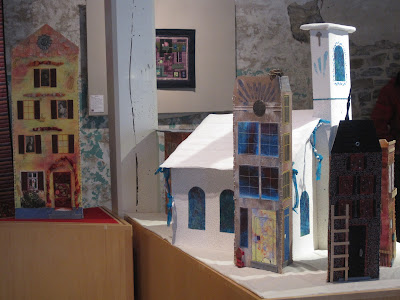
And while I didn't end up in a career related to architecture, I did land in one requiring very detailed work. My interest in buildings has continued, however, through my art, first painting, then in coloured pencil, then in 2016 designing a three dimensional village from repurposed items: cardboard, fabrics, used teabags, ceiling tile, an old table cloth, bobby pins and more. This village, titled Urban Refurbishment was part of the Colour Unboxed show of the Out of the Box Fibre Artists that same year at the Mississippi Valley Textile Museum.

While taking a psychodrama class in an expressive arts facilitation program, our prof suggested I further explore my fascination with houses. My thought at the time was that she was suggesting I explore the idea of "home", not "house", but I knew that was not the issue. 

I was curious, however, about where this interest came from. Both my parents were creative, as are many of my relatives: we have several writers in the family - journalists, an author, even a poet - all on my father's side. And knitters, sewers, tatters, painters and other creative talents on my mother's side. All this leads me to believe our interests can be genetic (we do have a geneticist in the family although I have not reached out to him with this question). Certainly my creative side comes naturally to me. But I was unaware of anyone else with the same enthusiasm for architecture or old buildings. Until now. 

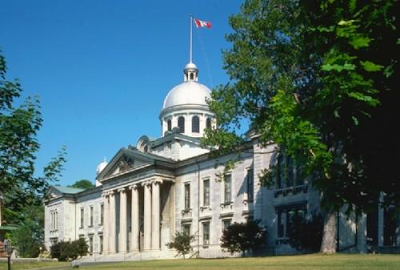
Fast forward to the present, and I may have the answer. My sister sent a link to an obituary about our great-great-grandmother. Said article also included information on her many brothers and sisters: it seems my great-great-great uncle on my father's side was an architect, and my great-great grandfather, also on my father's side, was both an architect and builder. From there we learned about a few of the buildings each had worked on, and just a two-hour drive away from where I live today.

Frontenac County Court House National Historic Site of Canada - My Great-Great-Grandfather is listed as one of the builders


Are our interests genetic? We know certain traits or health issues can be inherited. But interests? There are those who feel we carry the stories of our ancestors, that their experiences are woven into the fabric of our lives. Perhaps I am feeling some of their stories, and now I will also be able to visit the buildings they worked on.

Whatever the answer, what matters is this has given me a connection to my ancestral past, and I plan to continue pursuing this interest and see where it leads. Do you or someone else in your family have an interest that may have been passed down? Perhaps one that no one else seems to share? Ancestral memory may just be at play... 

Related:

Linking to our Past - through Photos


A SIMPLE VALUE SCALE

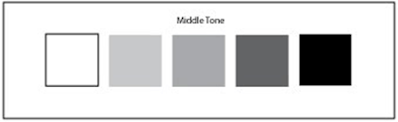
What if you try creating your art with a 4-value scale, instead of the typical 10-value scale.

Painting - or otherwise fashioning - a 10-value scale has been an exercise in many art classes I've taken. It can be intimidating, and didn't feel valuable to me. Oh, I understood the importance of learning about values, yet I was never really sure I ever applied the learnings afterwards, intimidated as I was by such a range of values on the scale.

Yet, the value scale definitely has, well.... value. Understanding how our value choices create depth in our pictures, add dimension, or impact through contrast, are important to our designs. Referencing and finding my way through a 10 value range, however, is overwhelming and intimidating.

Recently I listened to a two different master artists discuss the 4-value scale. This scale ranges from very light to very dark, with just 3 values in between - the idea was to use the dark and light, and 2 of the 3 middle values. What a welcome notion to me, uncomplicated, easy to follow and implement.  

Both master artists suggested this simplified scale would be instrumental in ensuring we include the much-needed contrast and thus higher impact, and backed up this intimation with several examples of the 4-value scale used in many famous paintings. I was sold. And, yes, indications are it's already helping my own art.

And I then realized that several visual and fibre artists I know who create stunning art are using this same scale, whether consciously or not.   

A few additional tips, while we're on the topic:

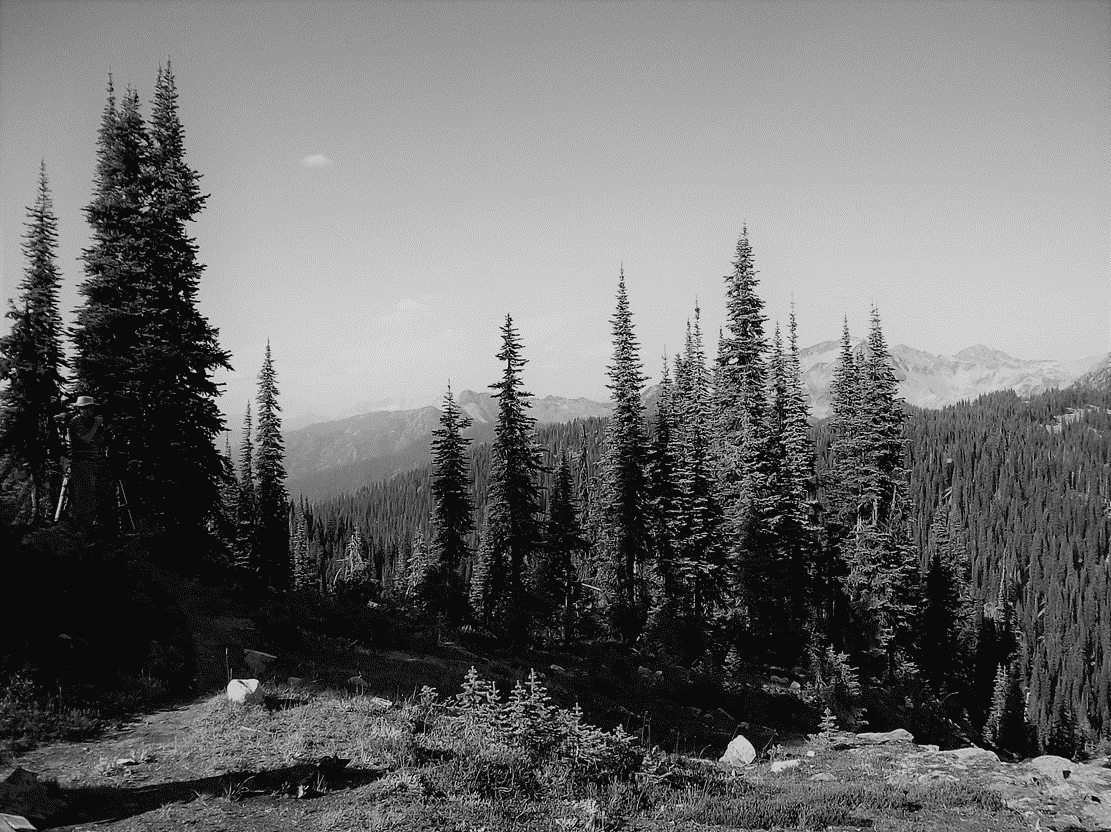
  • when using a reference photo, change it to black & white, it's much easier to see the values
  • squinting also helps to define values

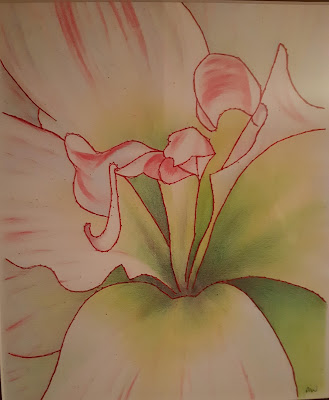
  • The darker values in this amaryllis are what gives it form, giving the illusion of the petals curving downward into the centre. Lighter values would have left a very flat picture. There is in fact very little "white" in this white amaryllis. It's the values that give it form. 


Related Blog Posts:

THE EARTH SINGING PROJECT

What do the natural world and singing have in common? Combining these two dynamisms into videos is a compelling approach to bring attention to the effects of climate change on our beautiful planet.

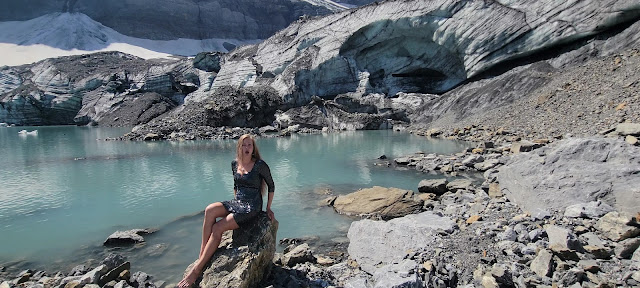
Katarzyna Sadej, international opera and concert and classically trained mezzo-soprano, embarked on a project 4 years ago to use her voice as an artivist to highlight environmental issues such as melting glaciers and deforestation. She recently discussed this project with Artivism: The Power of Art for Social Transformation, a multi-institutional collaboration to engage people in changing society through the power of art. Her presentation can be viewed through their Artivism YouTube channel.

Katarzyna, through travels in Switzerland, California and Canada, captured her voice in various landscapes on planet earth, while learning videography skills and operating a mini drone. She experimented with how the voice travels in rocky environments, in snow (it's absorbed), across water, even recording the song-like sounds of the insect world. She has taken hours of footage in the last 4 years, singing, pausing, listening to the quiet and sounds, her operatic style complementing each of the environments, connecting with the evolving landscapes.

Her close-up videos of the insect world caught my attention the most. Raw. Slow. Fast. Scales. Flittering. Layering. Mimicking. Experiential. I watched and listened to this part several times, thought how she so aptly married her voice into this unfamiliar environment.

Opera has not been a genre I have had an interest in following, yet she gave me an appreciation for the training, the hours of practice, and the difference between opera and classical voice. And of course, how the voice can be an instrument to highlight the issues we need to learn more about, to protect our world, to help our climate, to preserve its fragile beauty.

On a final note, Katarzyna also laughingly shared with us a blooper reel - turning the spotlight to the challenges she had to overcome, all the while learning to film in all kinds of weather - and in unexpected - conditions: low oxygen environments, wind captured by the microphones, and even cows. Yes, cows. But the importance of laughing at ourselves as we learn is a message we need to hear, a poignant reminder that, yes, we still have much to learn about preserving our planet.

Links:

Katarzyna's YouTube Channel

The Earth Singing Project Presentation to Artivism


FINDING THE BEAUTY IN DECAY, CORROSION, AND THINGS PAST THEIR PRIME

Every once in a while we chance upon art that leaves us awestruck. A jaw-dropping calendar of photographs I received in 2015 had imprinted on me the beauty that can be found in this world - and the equally staggering destruction of our climate.

The calendar was created by Louis Helbig, based on aerial photographs from his book Beautiful Destruction, of the Alberta oil/tar sands, and the messages he conveys through his medium and the guest excerpts by several well-known personalities.

This calendar still hangs in my studio, 7 years later, so struck was I by his work: the patterns captured from the air, the expressive perspectives, the barrenness of the landscapes. My hope was that one day I too could capture such beauty in my art, developing my own artistic eye to see these unusual lines, forms, movement and patterns.

While my focus may not be about climate change (although it is a meaningful and important topic), I have begun in the last few years to capture the lines we find around us, both natural and manmade, and often altered or corroded by the elements. My Lineations series has been all about these lines. 

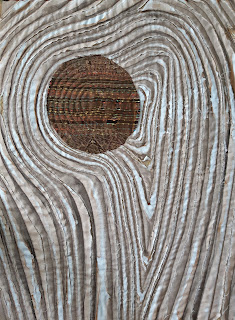
Tree Rings

I like to photograph these elements close-up, capturing snippets and affected areas that have rusted, corroded, decayed, weathered. The Japanese philosophy, Wabi-sabi is all about the beauty of things imperfect, impermanent, and incomplete, and plays a part in my art these days. This concept has given me a unique perspective as I look at the world around me. I now see with new eyes the beauty in rust, a flower past its prime, peeling paint, crumbling stone, the wrinkles in aging hands.

During a hike on a local trail last month, we happened upon a number of abandoned and rusted items - farm equipment, cars, a stove, fridge, tools - seemingly left behind on what used to be a farm in the 1950s. I likened these discards to outdoor art - and took many photos -  suggestive of ideas for my own future fibre art.


A few years ago I embroidered a series on hands - the aging hands of four women over the age of 80 - along with a small biography on each of the very creative women I picked. I'm still fascinated with hands, as there is so much history, wisdom, and experience in their lines and scars. I called this series "Hands of Time".


To represent the timeworn lines of my subject, I like to use the sew 'n slash technique of layering fabrics, then cutting and distressing with agitation and heat, as well as adding embellishments, all revealing the characteristics and secrets hidden below the surface. 

HEEDING MY OWN ADVICE

Okay, I admit it. My plan to do a daily textile practice with a specific piece of fibre art has fallen off the rails. I missed the goals posts on this one. Maybe it was doomed from the beginning because, after all, I didn't follow my own advice when making the plan. That advice being that, if I'm unsure of the next step on a piece, I should let it sit for a few days until the answer comes. That is exactly what my plan didn't include. And what I didn't follow at first.

But these last couple of weeks I did let it sit. I did turn turn to other works to create, and happily got drawn into those instead. So it's not like I wasn't doing something daily.

And then that lightbulb moment did arrive, which got me back on track with this piece, and gave me the next step.

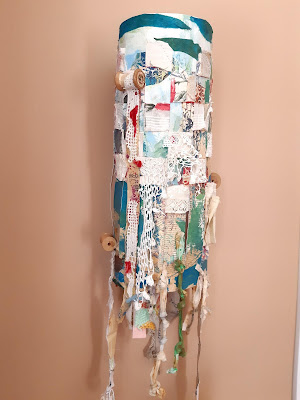
Quite simply, I realized it wasn't a piece to hang against the wall - it needed some shaping, forming, some kind of structure - to add some dimension. To change the conversation.

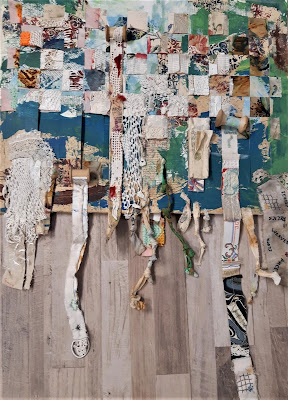
And so it is now a piece in the round. The hanging bits, which I didn't think worked earlier, now work. I also added more dark fabric around the top and bottom edges, adding contrast next to the lighter areas and hanging bits to help them pop somewhat. .

I really do like how it's hanging now. Is it done? I need to leave it for a few days to decide.

Related Posts:

6 ways to determine if your artwork is finished

Why Silence is Powerful in Art


WHY SILENCE IS POWERFUL IN ART

It's easy to fall into the trap of making art that is too busy. To add too many elements to our designs. When we do that, we dilute what is important, we lose sight of the message we are trying to convey. The focal point can get lost. And our art becomes less memorable. It's the quiet - or silent - areas of our art that gives power to what should be in the spotlight. 

We need to choose - and remember during the creation process - what we wish to take centre stage. To remove the elements that don't belong. We may be in love with a detail we have added and be reluctant to discard it. But if it doesn't add to our message, it needs to go. It needn't to be lost forever, it could simply become the focus of another piece, an idea to explore separately. 

Like in music, our art needs both quiet parts where we can take a breath, and energetic areas that are in the limelight. The silent, subdued areas of our art allow the eye to rest, acting like an interlude, leading to the more intense and emotional sections our eyes are drawn to, just like the climax in a musical score. This is the power of silence in art.

My latest additions to my daily textile art piece have led to busy-ness. There is now too much going on and not enough restful spots. My eye doesn't know where to look. I had very much wanted to add ties pieces at the bottom, hanging down below the art, but it now needs tweaking.

That back & forth process of adding, layering, masking, removing elements is a necessary part of the creative process. And remembering to add quiet bits. Just like the music composer, parts are written, erased, changed, altered again, arranged, and so on until we find the right fit for our message. We seek balance, harmony, and movement, giving structure to our compositions, setting the stage for our audience.

It means not rushing, as that will result in frustration and pieces we are not happy with. Taking our time is what is needed, stepping back, letting it unfold. Letting the process roll out, not focusing on the end results. It's a dance of creation that we are experiencing. Enjoy the dance. Enjoy the rhythm. Allow the quiet spaces to emerge, giving power to where the energy needs to live.

In my last post I mentioned I felt there was a bit of a "map" theme going on in this art piece. I haven't pursued this just yet - it may still be an element that comes through. I may need to add more areas that do look like water, which will add some of the much needed silent spaces. So maybe the map will still come through.

Related Posts:

Art Destruction, De-construction, Re-making

Adding Contrast, My Daily Textile Challenge

Art Challenges Online - Do they Work for You?


TYVEK EXPERIMENTS FOR 2026

Although I'm not a quilter, I am a fibre artist and do a lot of machine sewing, mostly random, improvised lines and some free motion. My...