Showing posts with label creativity. Show all posts

TYVEK EXPERIMENTS FOR 2026

Although I'm not a quilter, I am a fibre artist and do a lot of machine sewing, mostly random, improvised lines and some free motion. My thanks to Andree at Quilting & Learning - What a Combo! for hosting a linkup party to talk about goals and plans for 2026.

I started experimenting with Tyvek in the fall of 2025, after doing only a bit a few years back, monoprinting onto Tyvek, then layering with synthetic fabrics, sewing them together, and using a heat gun and/or soldering iron to melt back some of the layers. My focus has been mostly on leaves, inspired by fall colours, decomposing leaves, and especially ones eaten up by insects, leaving a beautiful skeleton leaf, and by the green and purple leaf shown here that I stumbled across on a local trail.


My process starts with gelli printing leaves and other natural materials onto the Tyvek, sometimes painting the Tyvek first. I may need to invest in a larger gelli plate to accommodate some of the items that are on my list, such as the tree trunk from a fallen tree that has those wonderful life lines. My current gelli plate is 8x10, and I think I need one of those new 18x24 plates. 

These are some of my leaves, the first photo showing some of the detail. I used floral wire wrapped in sari silk ribbon to make the stems.


My plans and goals for 2026 include more Tyvek leaves: different kinds, shapes, and experimenting by combining the Tyvek with other fabrics such as burlap,  rusted fabrics, adding fun yarns, painting with Inktense coloured pencils plus whatever else I can think of. 

And tree bark using Tyvek - the variations in colour and textures are yummy. As are trees that have patterns made from the ash borers. 

I have ideas for wabi sabi art, as I love the look of weathered wood, peeling paint, old stone walls and so on. Repurposed Tyvek is perfect for this. And I have lots of discontinued upholstery samples donated by a local furniture store to use up - these are perfect for the base for Tyvek art, adding texture and contrasting colour and patterns. 

What I'd really love is to spend time at a cottage or residency this summer where I can immerse myself in creating for a couple of weeks, away from distractions of home and other commitments. Someplace where I can find inspiration from local plants and other materials, and make enough pieces to be able to apply to some gallery shows.

There you have it, my direction for 2026. What are your creative plans for this year?

To see more of my Tyvek leaves and art, see my last blog post at https://annewarburton.blogspot.com/2025/11/tyvek-art.html


ALL IN THE FAMILY? COULD OUR INTERESTS BE GENETIC?

Growing up, I wanted to be an architect or interior designer. I signed up for architectural drafting classes in high school, and while I enjoyed the detailed layouts, I didn't love the precision required. But I was fascinated with all types of houses, especially older ones, the floorplans and the architectural ornamentation.

Trips to Europe and Asia introduced me to even more styles of buildings, from the narrow homes on Amsterdam's canals, to the temples of India and Thailand, to the renaissance elements of buildings in Belgrade, Serbia. My hundreds of photos have given me lots of references for future art pieces. 

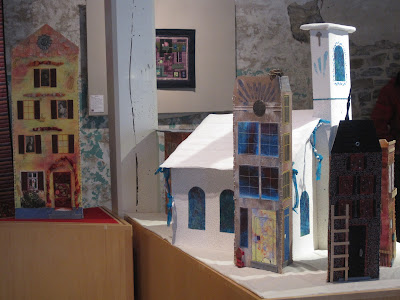
And while I didn't end up in a career related to architecture, I did land in one requiring very detailed work. My interest in buildings has continued, however, through my art, first painting, then in coloured pencil, then in 2016 designing a three dimensional village from repurposed items: cardboard, fabrics, used teabags, ceiling tile, an old table cloth, bobby pins and more. This village, titled Urban Refurbishment was part of the Colour Unboxed show of the Out of the Box Fibre Artists that same year at the Mississippi Valley Textile Museum.

While taking a psychodrama class in an expressive arts facilitation program, our prof suggested I further explore my fascination with houses. My thought at the time was that she was suggesting I explore the idea of "home", not "house", but I knew that was not the issue. 

I was curious, however, about where this interest came from. Both my parents were creative, as are many of my relatives: we have several writers in the family - journalists, an author, even a poet - all on my father's side. And knitters, sewers, tatters, painters and other creative talents on my mother's side. All this leads me to believe our interests can be genetic (we do have a geneticist in the family although I have not reached out to him with this question). Certainly my creative side comes naturally to me. But I was unaware of anyone else with the same enthusiasm for architecture or old buildings. Until now. 

Fast forward to the present, and I may have the answer. My sister sent a link to an obituary about our great-great-grandmother. Said article also included information on her many brothers and sisters: it seems my great-great-great uncle on my father's side was an architect, and my great-great grandfather, also on my father's side, was both an architect and builder. From there we learned about a few of the buildings each had worked on, and just a two-hour drive away from where I live today.

Frontenac County Court House National Historic Site of Canada - My Great-Great-Grandfather is listed as one of the builders


Are our interests genetic? We know certain traits or health issues can be inherited. But interests? There are those who feel we carry the stories of our ancestors, that their experiences are woven into the fabric of our lives. Perhaps I am feeling some of their stories, and now I will also be able to visit the buildings they worked on.

Whatever the answer, what matters is this has given me a connection to my ancestral past, and I plan to continue pursuing this interest and see where it leads. Do you or someone else in your family have an interest that may have been passed down? Perhaps one that no one else seems to share? Ancestral memory may just be at play... 

Related:

Linking to our Past - through Photos


UNFINISHED ART IN YOUR STASH? A GROUP PLAN CAN HELP...

How many art pieces or projects did you start in 2019 (or earlier) that aren't finished? If you're like me, I get excited planning and starting new projects, and make good progress on them up until the next idea comes along. Then my interest wanes and sometimes I finish them, sometimes not. On some pieces I'm unsure what step to take next, so the picture just sits until the answer comes, which may be months... or never....

Then I stumbled across an idea on a friend's blog - to post a list that is shared with others of those unfinished projects that we really would like to finish. The idea was to identify 12 outstanding projects, and target one each month to work on and complete by the end of the year. 

I shared this idea with friends in an open studio group, and was met with an enthusiastic response. A recipe for success we hope!

And so an excel spreadsheet was born and shared, and after a few tweaks, we each got our lists posted. 12 projects seemed reasonable, with monthly updates reporting on our progress. Some chose to add projects that hadn't actually been started, but ones they had been thinking about doing. I thought that was a great idea. While it would be nice to finish one piece each month, progress on a few is okay too as long as we are moving forward.

Sharing photos is of course welcome, as is asking for feedback, ideas, input, or whatever is needed to help us stay on track. But being accountable to each other is the best part. 

The goal of course is to have all the art pieces completed by the end of the year, giving us almost 12 months, but also not letting any new projects we undertake fall to the wayside. But any of those that aren't done will get added to a list next year.

"Now that’s all I want to do!  I’m very motivated..."
"I am excited to begin!"
"I am sure it will help me to finish my artworks, to give life to other works ..."

We are already seeing results after just a few weeks. I've managed to make a bit of progress on 3 of my art pieces, and finished one of the smaller ones - a fibre art interpretation of Electrified Cat's Moss. Although it had taken me months to find the right technique, once I did, it came together very quickly. And like the comment above, I too am motivated to get my unfinished pieces finished. 


I'll sign off this post by sharing a quote in Olympic speedskater and cyclist Clara Hughes' book Open Heart, Open Mind. This quote resonated with me, especially since I worked in sport for several years, but also because applies to any walk of life, and any type of project.

"You can only attract success for yourself if you want every single 
one of your competitors to be good and strong. 
When you wish good things for others, this comes back to you. 
The strength to be kind is not often asked for, 
but this is perhaps the most important strength to have."

Quote by an elder to Clara Hughes 


Very true.


SOMETIMES MAKING ART IS AS EASY AS FALLING OFF A LOG, OTHER TIMES GETTING BACK UP IS THE CHALLENGE

I purchased some old piano player paper a few months ago, seeing the potential to use some in in my fibre art. I didn't know just how I would use it, but the opportunity was there and the price was right. I was certain an idea would materialize at some point. I'm not sure how old the roll I bought is, although a copyright date of 1919 was given for the music itself, a waltz - Hand in Hand Again - and there were another 20 or 25 rolls available to buy.


Then in July when I was out with my outdoor sketch & painting group, I happened across a fallen birch tree with some marvelous patterns in the bark. I took photos, knowing I could make a picture in fibre art from this.

The piano player paper then came to mind, with its perforations that look similar to the horizontal line marks in birch bark.

I did a bit of experimenting to add colour to the paper, settling on bleeding tissue paper to add shades of reds and charcoals (it's a specially made tissue that bleeds its colour when wet). The white tissue didn't work as well, so instead I added torns bits of gampi paper, a very fibrous, whitish, translucent Japanese paper. I then mounted the piano player onto heavy brown paper bag to add some stability as the paper is fragile. Plus the brown of the paper bag can be seen through the perforations, just like the darker lines on the bark.

The next step was to add lots of stitching, following all the various marks in the bark. And then it was done. And I'm very happy with what seemed like an effortless piece of fibre art.


During the process a friend mentioned that it also had the makings of a map. She's right, and so I decided I would use the piano player paper once again but make a map this time.

😒 😣
The piece is coming along, but the effect of the holes in the paper has been lost. Perhaps I chose the wrong map, perhaps it's an aerial view, even if fictitious, that I need. I think where I went wrong was not to do more testing and experimenting, like I had done with the earlier one, along with my choice of paint rather than bleeding tissue. I was over confident this piece too would be as easy as falling off a log. I may finish it, but I think it's time to start, or experiment on, to make a new one.


LEARNING TO SEW - ON A SEWING MACHINE!

Although I learned to use a sewing machine when I was young and took sewing in grade 7, the results and the projects I made didn't exactly encourage me to keep trying. 

And although I've had a love of fabrics and a desire to create using fabric and textiles, I rarely used a sewing machine again until a few years ago. Oh, from time to time I'd decide to try and make something simple, but it was usually an exercise in frustration. I didn't take the time to measure properly, the tension always seemed to be off, a needle would break. I had (sort of) learned to sew, but I never learned how to use the sewing machine properly. And so I would put the sewing machine away again until I drummed up the courage to try again. I knew I should be able to do this, I have cousins who are beautiful sewers.  But instead of taking the time to learn the machine, I let a combination of mindset, lack of patience and lack of confidence deter me.

Then about 3 years ago I signed up for a 2-day workshop through my fibre arts group, one where we were learning techniques using a sewing machine. What's that saying?
"when the student is ready....". It was time for me to learn.

Before the workshop, I did familiarize myself with my sewing machine so I could quickly change threads, bobbin, even change a needle if needed. And I had the previous year tried sewing on cardboard and doing other fibre techniques on my machine. The results were okay, but enough that I was interested in learning more.

Through this workshop I learned the limitations of my basic sewing machine, but also discovered it was a workhorse. And, more importantly, I gained confidence in my sewing ability, and learned that it didn't matter if I could sew a straight line, it was the techniques, and the possibilities arising from these techniques, that caught my attention, from couching on ribbons to layering materials, to encasing sequins, all using this machine that had eluded me for years. 


Since then I've used this workhorse more and more, but its limitations prevented me from more experimentation. It was time to trade it in the old model for a new one. I wanted one that would do free motion embroidery, would be able to handle thick materials including cardboard, have an extra wide extension table and, most important, have an embroidery foot, walking foot, cording foot and other useful feet to expand my world even further. 

After researching brands and models, and reading many reviews, I found the one I was looking for. And I realized just how much knowledge I had already gained about tension, needle sizes, thread types and so on.

So now I am playing with the new sewing machine, experimenting, without the frustration I used to get. Well, most of the time - I still need to remember to lower the embroidery foot before I lower the needle so it doesn't jam. And it seems each day I learn something new, like using the walking foot for a piece that is 10 layers of fabric. I can change the presser feet quickly, filling the bobbin is a piece of cake.  I'm playing with the pre-programmed stitches, experimenting with materials, and have actually started to make some of the projects that have been on my list, and which would have taken so much longer had I had to hand-stitch. Now I love hand-stitching, find it calming and meditative, and so will not give that up, but some projects will be faster and I can combine the two.

The piece below is on a blue velvet-like material, onto which I added 3 colours of foil. I then stitched a layer of tulle over top of Angelina fibres, and couched on a blue metallic ribbon. 

This sample is a material slashing technique, made with 5 layers of fabrics stitched together then cut, or slashed, through varying layers. 

This last piece is a variety of fabrics - upholstery, drapery, organza, and old lace, stitched together with free motion straight stitches.


DOES PRACTICE MAKE PERFECT?


I often hear from people that they cannot draw or have no talent for art. That sitting down and starting to draw or paint or play a musical instrument is not something they could do.

Most of us cannot. Picture the child learning play basketball or use a skateboard. It takes determination and practice. We see skateboarders practicing the same move over and over and over until they've mastered it. Coaches too use skills and drills to help children and adults learn the techniques, practicing and building upon what they learn, until muscle memory kicks in. 

The same holds true for drawing and learning other art techniques and for playing an instrument. We need to learn the techniques to transfer what we see to paper, to practice the musical instrument and to learn to read music. 

Whether we are self-taught or taking a class, we can learn at any stage of life so long as
  • we have the desire
  • what we are learning is meaningful to us, and 
  • we are willing to take the time to practice, then practice some more, then practice again. 
Practice helps us become not only technically proficient and build muscle memory, but also so we can breathe life into a piece.

It's easy to keep practicing what we know, not so easy to practice what we don't know. But practice is what it takes to become good, even a master at what we create or the instrument we play.

And it's important to be present while practicing, concentrating, mindful, struggling to get through the bits that we find challenging. To not be present means we are just practicing without really paying attention, not noticing where we could improve. 

That's the challenge I faced when I was growing up and taking piano lessons. I disliked practicing, especially scales, and wasn't actually that interested in playing. So while I practiced every day because I had to, I never learned to play well and I don't play today. 

And it was a pleasure to watch several women in a retirement home learn to draw using coloured pencils. Most had only started to make art after moving to the home but they enjoyed it, found meaning by creating pictures from old photographs, and practiced between classes, improving to the point where some of the pictures even made it into an art show at the home!


ANNUAL THEME? OR VISION BOARD?

Do you set an annual theme? Or make a vision board? Or maybe both?

I started using an annual theme as a tool a few years back to keep sight of the direction I wanted to go in. The theme can cover personal quests, family, work, creativity, hobbies, health, bucket list, financial, and more, essentially whatever areas you feel you need or want to work on. It can cover all of these or a few or just one area.

The theme does not identify a specific goal such as "lose weight" but is more general in nature. For example "reduce" could cover a number of areas you wish to work on: losing weight, reducing spending, getting rid of clutter, watching less t.v., and so on. 

Discovering your theme for the year is usually done after setting goals or creating a vision board, but for some there could already be a theme you’ve been working towards that you have intuitively figured out. And not all of us follow the calendar year to set or re-set a theme. I seem to update mine about every 8 months or so. 

As you set goals for the year or make a vision board, a theme starts to emerge – one of mine from a few years ago was “connecting” and for another was "building successes". This latter one was not just about, well, building successes, but also about creating three dimensional fibre art buildings for an art exhibition, the first time I had worked in 3D.  Other people have identified intentions and themes such as “slow down”, “network”, “healing”. Usually one word or a short phrase is all that is needed. 


Vision boards are a process to help us create the life we want, a visual representation that we see daily to remind us of the directions we wish to pursue and the goals we set. Just like the theme, it can cover many areas or a key goal or purpose. It's an intuitive process, unlike the theme that describes a connection among the areas we wish to work on. Thinking in pictures can be a very successful way to keep on track, a form of visual journalling or storyboard, speaking to us in images and symbols. Athletes are a great example of people who use visualization techniques to pursue their goals and achieve success. 

Goals identified on a vision board can be big ticket items, but could also be steps that you wish to take toward something bigger, leaving us feeling less overwhelmed. It can be a good way to get started on something new: a workshop you want to take, a new exercise to try, connecting with family every Sunday - things that are of significance to you.

Creating the vision board helps us dig a bit deeper to see what our heart desires. By working with images, we are accessing our dreams and creative side, not just our logical brain to discover what we need to focus on.

I've been making vision boards for a few years now, and recently came across a very different way to create a board, digging even deeper than before. I think this new vision board will fit perfectly with identifying a theme for the upcoming months.  

I will share this new vision board process in a future blog post, once my board is complete and with some feedback from others who are using the same process. It's a process I already think is better and I'm excited to see how my board turns out. 

Do you set themes or create vision boards? I'd love to hear from you.


TIPS TO OVERCOME MENTAL FATIGUE WHEN VISITING ART & CRAFT & VENDOR SHOWS


Craft show and bazaar season is upon us. Do you find you get overwhelmed with all there is to see? Are some shows too big with too many sellers? Is it hard to get to see some areas due to the crowds? And there are often multiple sales close together in one day - craft, flea markets, farmers markets, bazaars, rummage sales, food sales, art, direct sales, and on the list goes. 

It's easy for mental fatigue to set in when there is too much to see - a seemingly infinite amount of goodies in front of us. We can't possibly take it all in. Whether you're at the sales to buy goods or find bargains, or just to be inspired and get new ideas and replenish your creative reserves, we can quickly become over-saturated by the plethora of offerings. Our concentration wavers. We drown in details. We make poor buying decisions.


So how do we get around this type of fatigue that can set in at these shows & sales? Try this hack for both recovery and to see what you missed the first time: 


  1. Take a break. This may seem obvious, but taking some time to clear the mind helps make room to absorb more information. Write down or record some notes so you don't have to keep juggling all those thoughts. Then take a walk (outside is best if possible), drink some water to stay hydrated, eat a snack if you're feeling hungry. When you're ready, go back in.
  2. You should be feeling refreshed, but this time, go around the room & rows in the opposite direction. You'll see everything from a different perspective and, like a veil lifting, will be able to take in details you didn't absorb on the first go around. Your eyes and senses will open again. 
My recent trip to the Toronto area is proof-positive. The visit was to see an exhibition of fibre art, my goals were to see the works of the international artists, to be inspired, to perhaps see a few techniques what would help with my own work. 

Part way through the visit, however, we were feeling overwhelmed. We were no longer absorbing what we were seeing. Information overload was setting in. There were over 300 artworks, each needing some time to see not just the big picture, but also their intricate and often sophisticated details.

A lunch break and time to get away definitely helped. But seeing the works in the reverse order was key, or the fatigue would set in at the same point as the previous visit. By seeing the latter half of the show with fresh eyes, we were able to absorb more details than if we had started at the same spot from earlier in the day.  

Give this a try next time you're at all these shows, indeed there are lots of places where this hack could help. And if you're a seller, this idea is worth sharing or visitors may just be walking by your booth with eyes glazed over....

FOLLOWING A HUNCH.....

"The next thing I knew, I was buying notebooks, the cheap student kind, and filling them with what I thought of as clues, although at this point I had no idea what the mystery was, just that something had shifted inside me, revealing a burning desire to know." Mickey Hart, Grateful Dead percussionist, in his book Drumming at the Edge of Magic

Does this quote resonate with you? It definitely does with me, especially the part about not knowing what the mystery is. 

When was the last time you felt drawn to exploring something? Felt intrigued about a topic, or perhaps just feeling some restlessness? Did you trust your intuition and follow a hunch or opportunities presented to you? What was the result? If you didn't follow the longing, is it still with you? You may not know yet where it will lead, but it's a path that could bear some interesting results. 


I love books. I go to several used book sales and used book stores each year, usually to stock up on novels to read. But this year I've felt drawn to finding books all about creativity, idea generation, imagination, the science of art and music, visioning..... And I've hit the jackpot at a couple of sales, quickly growing my stash of creativity-type books this past spring and summer from the 8 or 9 I already had to well over two dozen.

Some of the books I've now read, others only thumbed through, and others have put aside for another day when I can study them more deeply. I've tagged several pages, written notes about others, and marked some items for thought and reflection. Several of the books have intriguing creative exercises which I have started to explore one by one.

I'm excited to see the results that will come from all the reading and experiencing the creative ideas being presented to me. 

Why? I am only beginning to scratch the surface and understand what I may be looking for. The more I read the more I seem to be reliving expressive arts classes I took a few years ago and the powerful art and music activities we experienced. And trusting in this kind of creative process, not quite knowing where we are going - or even the next step -  but with patience and a belief that this act of faith will lead to something important. 

I'd love to hear your story about following a hunch. 

GUEST POST: GETTING PAST THE HUMP IN A CREATIVE PRACTICE

Guest post by Renée Gendron MA, Business Development consultant, Co-founder and Chief Information Squirrel, Author 


I set a goal to write 1 million draft words of my 1.8 million word series in 2018. That’s 5,000 pages. Although I’ve written other books and short stories, this series is the first that has the potential to be commercially viable. I reached that goal on August 31, 2018, and I’ll work towards my stretch goal of 1.8 million words. I’ve been stumped. I’ve written myself into corners. I’ve had to redesign characters and do some deep thinking on magic systems to ensure that my world was logical and internally consistent. And I continue to have to fix problems with plot, structure, characters, and endings.

I’d like to share with you some components of emotional, psychological, and professional resiliency that you can use in your creative work whether it’s writing, Painting, performing arts, composing, or some other artistic endeavour.


Put your Pride Aside

It’s not easy creating something. What gets typed up on a page, painted onto a canvas, inked into a score, often isn’t what you initially thought it would turn out to be. I wrote a romance scene where the heroine and hero fell into each other’s arms and fell madly in love with one another. A perfect ending to a beautiful story. Romantic, eh? The problem was when my beta-readers reviewed it, they pointed out the glaring flaw that the conflict the heroine and hero had just a chapter ago wasn’t resolved, that it didn’t make sense in context for them to wrap each other up in their loving arms and that the scene was flat. No spark, no desire. Ouch.

I rewrote the scene with their advice, looked at the margins where they scribbled notes and questions, answered them all in the rewrite, and ended up with a better chapter.


Lesson

To create the best product (art) you need to open yourself up to feedback. Open to feedback from people who have more experience in the art than you.
A chapter may not make sense. A composition may lose its rhythm or not synch well with other instruments. A piece of weaving may not achieve the desired pattern. A painting may work best when another technique or perspective is used.

Sometimes you’ll have a creative difference with the person providing the feedback. Other times you’ll have to have a think about how to rework it, how to incorporate the feedback, how to make it fit for what you want to achieve.

It’s not easy, but you’re better off for it. Sure, there might be some creative differences, but you asked them for feedback. You won’t get better unless you take that feedback and rework it into your work.


Stuck

There are days where my brain doesn’t want to cooperate. I have an idea in my head, it’s clear and crisp, but when I go to type it up, it’s garbled and flat. There are days where I can’t get a piece of the story to work, the plot twist that I thought it would turn out to be a gentle slope, uninteresting and predictable.

I think I write goodly 😃, but then it comes out as making no sense. Sometimes it’s because I’m tired, so I take a break. Sometimes, it’s because I’m dehydrated and I can’t think clearly in those situations. Other times, it’s because I need to improve my skill level.

Lesson

Budget your time and money.

I budget time and money for professional development. If you don’t have a lot of money, that’s okay. You need to allocate more time. For example, I read a lot of free articles online, listen to free podcasts, and participate in free forums about my craft.

I also allocate a professional development budget, and I participate in conferences, workshops, and online courses. The better I get, the more tools and tricks I can use to overcome a technical challenge.


Support Systems

It’s nice to have your spouse or sibling ask you about your art. And then you see their eyes glaze over when you become animated and enthusiastic about your work. Your spouse, your children, your siblings, are likely to smile and nod when you show them a new creation, but they often don’t share the same passion for your art as you do. That stings and can discourage you from pursuing it.


Lesson

Find and surround yourself with people who are equally passionate about the type of creative practice you do. I’ve developed an ecosystem of individuals associated with publishing and writing to help me through this project, and I’ve expanded my network in this area. With them, I get technical about writing, engage in deep conversations about the craft, go to conferences with them, share resources, and talk until lose my voice about all things related to writing. But when it comes down to it, I still need to put my fingers to the keyboard and produce.


Motivation

I love writing. I took a fifteen-year break from writing – though I can’t remember why I stopped writing, and when I came back to it, I remembered how much I love it. I find editing difficult and less entertaining. When I don’t feel like doing it, even though I know I have to do it, I break it into smaller chunks, I learn techniques to make it less of a slog, and I keep reminding myself that I need to do this to achieve the end goal: a well-written, polished, book.


What’s your motivation? What drives you to do what you do?


Take that idea, then apply the points of this article from bottom to top.


Renée Gendron MA

I’m the founder of Vitae Dynamics where I help companies and communities improve their economic resiliency. I think Canada needs to create 6 million full-time jobs to ensure prosperity for all. You can like my Vitae Dynamics page on Facebook and/or follow me on twitter under @vitaedynamics.
My website is http://reneegendron.com/index.html

I’m also the co-founder of a clean agricultural company. We offer a range of organic certified whole life cycle products that reduce the need for antibiotics, reduces greenhouse gas emissions, improves air quality in barns, and boost yields for farmers.
If you’d like to follow me for my writing, please do so on twitter @reneegendron I’ve not posted much yet but will do so soon. I will probably post a lot about squirrels because they are awesome.

DO YOU REMEMBER NAMES OF PEOPLE YOU'VE JUST MET?

How often do you hear someone say "I'm really bad at remembering names"? I'm one of those. I was told a few years ago that we have to say someone's name 3 times when we first meet them in order to remember it. Uh huh. That didn't always work for me.

Then I met someone this week (gosh, what did she say her name was ?!) who asked how I spell my name, specifically with or without an 'e'. She explained that she remembers names by "seeing" it as a word and with all its letters, so she always check the spelling, even when it's a simple name.

It occurred to me later that she must be a "visual" learner. Approximately 65% of the population are visual learners, 30% auditory, and the remaining 5% are kinesthetic.

Auditory learners are naturally good at remembering names and at finding ways to do so. Kinesthetics need to feel some kind of connection with you in order to remember your name. 

Visuals will remember a face, but not the name. Since 65% of us are visuals, it's no wonder I hear so often from people how bad we are with names. By working with images, perhaps this idea of seeing the name written out is just the trick we visuals need to cement a name to memory. I will try this next time I meet someone and check how they spell their name. And if you give it a try too, let me know if it works for you!

Anne - that's Anne with an e - Warburton
Visual Learner, Fibre Artist and Blogger

MUSIC (AND HARRY POTTER MAGIC) TO ENHANCE CREATIVITY

Members of Urban Sketchers Ottawa were thrilled to be invited to a dress rehearsal this past week of Harry's Musical World by the Ottawa Pops Orchestra. About 20 of us attended on Friday afternoon at the start of the long weekend. It was not only a wonderful opportunity to practice sketching people and the orchestra, but to also sketch while listening to the orchestra play music from the Harry Potter movies.

I was spellbound listening to the musicians as they warmed up prior to the rehearsal. The little snippets of melodies, varying keys of music,  flutes, violins, trumpets, trombones, together harmonized with my quick sketches which took on a loose, feathery look. 

Once the full rehearsal started, I would become transfixed with sketching and was no longer consciously aware of the music. Other times when the tempo changed to more powerful score I was transported into listening and forgot to sketch.

But wait, can music really enhance our ability to be creative? You bet! But it's important to choose a style that fits the goals to create and whether you are in the beginning stages or latter stages of a creation.

Music accesses the right, creative side of the brain, and different genres affect our moods in different ways. From high energy music that is stimulating to low energy that promotes relaxation, our bodies sync with the music's tempo and intensity. Repetitions in the pieces can also have an impact, as can the types of instruments being played. 

Some examples: If you want to create from a place of passion & energy, playing rock music will help. Country and big band music help access memories, Jazz and blues stir up strong emotions, and sacred music promotes feelings of peace and grounding. Classical music aids spatial perception, new age music can bring us to a state of relaxed alertness, and salsa is great for creating movement in pieces. Shamanic drumming and Gregorian chanting provide calm and work very well for pulsing and repetitive actions. 

So choose the music that best fits what you are trying to create. Don't choose loud music to do delicate work that needs a slow pace. Rock or heavy metal or salsa when painting on a large canvas with broad brushstrokes may work just fine however. When focus is needed, music without vocals is best so the brain is not distracted by the words.

And if you're not finding suitable music, try humming or playing an instrument to get you into the creative spirit. 

The music of Harry Potter is probably not what I would regularly choose when I want to create, but being able to draw to live music rather than a CD or download is an experience I'm glad I was able to participate in.
----------------

Urban Sketchers Ottawa is a group of sketchers who share sketching opportunities and events around the city. There is no membership fee, and sketchers of all levels are welcome to join. For more information, visit their Facebook page at Urban Sketchers Ottawa. 


PREPARING TO CREATE / GETTING INTO YOUR ZONE

High performance athletes get in the zone when competing, quieting their minds, breathing, focusing, visualizing every move they need to take, even following a set routine and rituals in the seconds before leaving the start box. They may not be able to eliminate all distractions but do get to a point where they can keep those distractions at bay. Their preparatory routines become so ingrained that it could throw them off course if not followed to the letter.

It is rare that I see artists use any type of centering as they begin creating each day. We enter our studio and just expect to create. Yes, some go through rituals such as tidying up first, placing the materials they need at their side, perhaps making a cup of coffee or tea. Others feel the need to get chores out of the way before they focus on creating. But our to-do list of distractions never ends, and can sometimes be a delay tactic when there is uncertainty about steps or a technique for a piece in progress or a new piece of art, or when we are not satisfied our art is good enough.
As artists we are not taught the benefits of getting in the zone to prepare for creating or coached in techniques to get into that zone. Rather we hope we will find our focus once we have started our creative activity. Sometimes we do. And sometimes we don’t get there at all and find all kinds of other tasks to distract us. When we do discover the value of getting in the zone early, it’s usually through discussion with others or by fluke. Unless it’s a meditative style art class, it’s unusual to be led through an exercise in classes and workshops to find our focus or to be reminded to centre ourselves. Instead, when the gun goes off, we are just expected to begin creating.

Since taking up yoga a few years back, more and more I am able to quiet my mind, slow down and find focus like the athlete who gets into the competitive mindset. When I then applied similar steps to my art, trying various meditative practices to see what would work for me, I discovered I do my best creative work when I read first, something that gives me pause for reflection rather than fiction or world news. I follow this with a few minutes focusing to set an intention for my creative work that day, visualizing the project at hand. I am then ready to begin and am in a much more relaxed state than when I started. I am getting into my zone. And I am able to push aside distractions that arise.

There is no one right way to get into the zone. And everyone finds their way is different from someone else, and may find they need new ways over time. And of course some days are harder than others to find that focus. For some, sitting quietly and focusing on the breath works, others prefer to take a walk, or sit outside focusing on the sounds of nature. Gentle movement can work too. Other rituals may include lighting a candle, putting on quiet music, pulling on a favourite shirt to wear. Visualization and setting an intent are the important areas to focus.  

Overall I’m happier with my art when I follow this process. Without it, well, let’s just say I’ve had some successes but also more failures than I care to admit. In the zone, I’m much less tense about the outcome, in a more relaxed state of mind, willing to pause, not rushing, not pushing, and truly pleased with the creative results.

TYVEK EXPERIMENTS FOR 2026

Although I'm not a quilter, I am a fibre artist and do a lot of machine sewing, mostly random, improvised lines and some free motion. My...