Showing posts with label creative benefits. Show all posts

Artivism: The Power of Art for Social Transformation

It's been several weeks since I've written a blog post. I think I needed a break from writing then I got busy with other projects and activities while enjoying the autumn months.

But there is one event I wanted to mention: I was honoured earlier this month to make a presentation as part of an Artivism initiative by Adelphi University in New York. They have been arranging a series of guest speaker presentations that demonstrate how the arts can make a difference in creating awareness and for social change. The presentations cover not only visual arts, but also music, performance, community projects and many other initiatives. There are presentations via Zoom most Mondays, and are uploaded to their YouTube page afterwards.

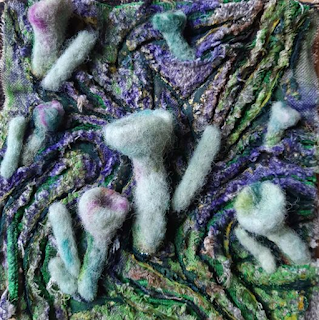
My topic as part of this initiative was Embracing the Natural Art Around us for Self-Reflection and Personal Growth. in which I speak about my how my art represents timeworn and weathered objects around us, both in nature and manmade, and how it can help us find connections and create opportunities for self-reflection, growth and gratitude.

I think it went well, and my friends tell me they gained insight into the meanings behind my art. I invite you to watch the presentation at the link above. I'm pleased that I've had lots of opportunities for public speaking over the last year - all that practice definitely helps. And it really is easier to speak to an audience when it's a subject we are passionate about.

I was referred to this Artivism initiative by my good friend, international tapestry weaver Krystyna Sadej, who made a presentation on Art Made of Recyclable Materials. hHr husband, Andrzej, Paralympic Head Coach and Coaching & Education Director with Judo Canada, will be presenting on Monday, November 21, on Social transformation in the art of judo by developing a program adaptable for the visually impaired, alongside his athlete, Priscilla. Krystyna's daughter, Katarzyna Sadej, international opera and concert and classically trained mezzo-soprano, spoke this past spring about her Earth Singing Project, 


Related Links:


IN TIMES OF STRESS, CREATIVE ACTIVITIES HELP

In stressful times, creative activities can help. Indeed, numerous studies by medical doctors have shown creative endeavours can help improve our well-being:
  • lessening anxiety
  • keeping us grounded
  • helping us reach a calmer state
  • bringing out positive feelings
  • lowering blood pressure
  • reminding us to enjoy and laugh
  • keeping our hands busy
  • distracting us from stresses
  • providing a sense of purpose or accomplishment
Any creative activity you enjoy can help, and many don't require us to go out and buy supplies. Some ideas include: sing & dance, colour, decorate cookies or cupcakes, take fun photographs, make some videos, garden (when it gets a bit warmer - or take cuttings from your houseplants to start new plants), declutter, rearrange your furniture, do some improv (start a story where each person adds 1 word or 1 sentence), learn to make paper airplanes or origami, get outside for a scavenger hunt, write. 
Pretty fabric covers up several little holes

Some have a practical side too, like sewing or learning to sew on a button or mending our clothes instead of going out to buy new clothes. Google "boro mending" to find some great ways to work around holes and tears in clothing while make some very creative designs.

As a local weaver said: 
"I for one find my weaving to be a good antidote to everything I'm hearing on the news.  I often nowadays feel a bit numb after hearing the news, and sitting down to weave keeps those numbed feelings and thoughts moving freely and gently in a safe space."
Sharing what we're working on by uploading pictures, phoning a friend, emailing, helps to keep a sense of connection within a community. 

The important thing is to try to do something creative every day.  It really can be a good prescription to stay positive and enhance our well-being. 

Stay well


REPAIR, RECYCLE, ALTER - YOUR WORN OUT CLOTHING

Most of us are pretty good about donating clothing we no longer wear to thrift shops or rummage sales. But what about those items that cannot be re-sold, items that are damaged, torn or stained. After all thrift shops look for clothing to re-sell that is in good shape, clean, and odourless. 

Clothing that cannot be re-sold may be sent to places that repurpose them into rags or upholstery stuffing. Some will turn cotton into papers. Some gets sent overseas to be re-sold, and a small percentage does go into landfill. 

Before you get rid of your blemished, no longer perfect, in need of repair clothes, have you explored options to revamp, repair or make alterations? To extend the life of that favourite sweater or t-shirt? Here are some ideas to get the creative juices flowing:

  • If the hole isn't too big it can be darned. I know, I know, that was something our grandmothers or mothers did. But, really, the tidiest of repair jobs means the item is wearable once again. There are plenty of videos available online.  Of course it may take a bit of practice at first, but it's worth the effort to save a favourite piece of clothing. . And if the clothing has several colours or tones of one colour, the darning stitches just blend right in. Can you spot the repair in this picture? With practice, my repairs will improve even more. It's just below the arm hole so is barely noticeable. Of course, if you don't want to try this yourself, there are plenty of tailors available who will do the repair for a minimal cost. 


  • If after mending it shows up too much, adding some embroidery around the hole could do the trick.
  • Larger holes or stains can be covered with something another fabric, something that is complementary. Sashiko  or Boro - from Japan - and Kantha - from India - are all about patching up clothes and other textiles with scraps of cloth and with embroidery techniques specific to these regions. It also helps to strengthen fabrics, extending their lives even further. And no one says they patched parts have to match, they can be very colourful and funky, nothing like those old iron-on patches we used to see. This concept of repairing embraces the concept of "wabi sabi" which is about see the beauty in the imperfections and impermanence.
  • Old wool sweaters and blankets can be felted in your washer & dryer and cut into place mats or pot holders. Here are a few I've been working on. 

  • In days gone by, fabric scraps were recycled into beautiful quilts or cushion covers or other memory keepsakes - is there one hidden in your linen closet that has been passed down through the generations? I do sometimes see quilts made today from collections of old t-shirts or shirts which make wonderful keepsakes, especially when we have difficulty discarding a quantity of items that still have meaning.

    Or perhaps the scraps could be used to cover a mirror frame, like this one, or collaged onto a canvas, to make a piece of art.


  • Consider tie dyeing, bleach dyeing, sun printing, eco dyeing, fabric painting and more. This shirt was solid black, and after bleaching, turned this marvelous shade of brown. I used elastics to create the dark rings during the bleaching process.

Of course us fibre artists now look at old and damaged clothing in a whole new light, wondering if it can be altered or incorporated in some way into one of our projects. We collect fabrics for repurposing. If you also collect such materials, what suggestions do you have for altering or recycling?


WELCOME TO MY BLOG ON CREATIVITY

Reading time: 1-1/2 minutes

I've long been fascinated with how creativity works, with the impact of colours on our moods, the therapeutic side of art and music, how an 'aha' moment can appear seemingly out of nowhere, and why some people say they are not creative while others seems to have the most vivid imaginations, .

If we think back to when we were children: we coloured, made up stories, explored, built forts. Somewhere along our journey we moved away from this playful and inventive side.  Yet so many of the activities we do today are creative: gardening, how we decorate, taking photos, problem solving. But still people some do not feel they are creative, likely because we are not in the habit of thinking and living creatively. 

When we practice being creative and surround ourselves with inspiration, the practice becomes easier and unfurls into even more creativity. It can be re-discovered at any age. I certainly saw this when teaching coloured pencil drawing to women in their 80s and 90s, many of whom had only begun to explore art-making a few years before. I've had the pleasure of watching emerging artists of all ages overcome their fears and begin to display their art, and have worked with and led teams to find new visions in event planning and in staging art shows. 

I was fortunate during my working career to have had two highly creative bosses, two men who I learned more from than anyone else I had worked for or with. I was often blown away at the solutions and ideas they would come up with. They taught me to look at issues from different perspectives to find innovative answers.

As a life-long student of creativity, I decided to start this blog as there is much I would like to record about what I have seen and learned, and to share these thoughts with you. I welcome your observations, feedback, questions. So, stay tuned, and I hope to publish a new blog post of my creative musings Sunday evenings, hopefully two or three times each month. Read on for the first entry. 

TYVEK EXPERIMENTS FOR 2026

Although I'm not a quilter, I am a fibre artist and do a lot of machine sewing, mostly random, improvised lines and some free motion. My...