Showing posts with label principles of design. Show all posts

ADDING SOME CONTRAST - MY DAILY TEXTILE CHALLENGE

This is an update to my post earlier this week on my textile art challenge. I've been doing a little bit most days, and this piece as part of my new Daily Textile Practice has taken an interesting turn.

I've sewn on a few bits and cut through the layers of some fabrics to get some movement in the piece. I also added a fabric with a pattern I wasn't fabric, but one which I did a bit of eco-printing on - the colours seemed to be a good fit.
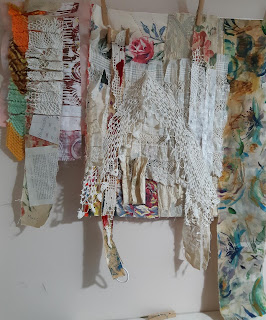

Sometimes a piece seems to take a lot of work and many layers before we feel it coming to life, before it turns into a dynamic art piece that reflects the message that we want to convey. This is a very normal part of the creative process, yet one that many people can get hung up on. As one art teacher has so rightly pointed out years ago "art has to go through an ugly stage before it becomes beautiful". It's taken years of art-making for me to learn patience with the progress and building of layers.

For this particular textile piece, I was expecting some construction as well as de-construction, that I would be taking two steps forward and one step back, aa and that at times I would feel some frustration at progress. 

But stepping back to allow the next steps to come to us is important.

A quote from an interview with Paul McCartney that I read recently can really help:

"...What I normally do is just leave it and let it marinate. Then [I] either go back to it and think, "Oh, you know what, that bit of the lyric is OK but I need to fix it," or write a complete new set of lyrics. But I think everyone gets the block from time to time."

Can you relate to this? And this isn't just a name of someone we don't know, but a real artist we are all familiar with.

As I worked on my piece, I was feeling that while the colours were harmonious, I was a long way from creating a dynamic look. 

Then, while tidying my studio, I came across 2 painted/mixed media papers done in a class a few years back, mostly paper, with some stitching, but never finished.  I had kept them in case one day, you know, I would find the use for them.

One I thought was the right fit - shown here with the houses - I have loved making art of buildings over the years, and this one to me added a bit of sense of home. And yet it wasn't as harmonious as I first thought it would be. The colours were a bit off, as was the scale, throwing the whole look somewhat off balance


So I tried the second art paper, more of an abstract - which at first I was reluctant to use - I feel it fits so much better. The colours are harmonious. It adds some contrast, which adds interest and has potential to make some areas pop. 

Do you agree with my choice? Here are the photos of the abstract one. I've included black & white photos too which are better at showing off the darks and lights. 


WHY LINE IS IMPORTANT IN ART

Lines, one of the design elements in art, are descriptive, the backbone of a design. They help to move the viewer's eye around a piece, can convey texture, be musical, or quiet, are harmonious or add vibration. They can be lazy, energic, elegant, rhythmic, and demonstrate emotion - picture an angry line versus a happy line. 

Lines can be hand sewn, continuous, dotted, smooth or ragged, machine sewn, couched, needlefelted, beaded, woven, painted....

Lines are everywhere, if only we take the time to look: the veins in leaves, the marks left by the ash borer beetle on an ash tree, the rings in tree wood, even the edges of stones or ripples in water. In reality the lines on stones and the water don't exist, it's the transition from one surface to another that we see, examples of outlines or contour lines that help form a shape. 

My sew and slash technique is all about lines - and contrast added using colour and texture. My best works are 4 to 6 layers of fabric. And sewn lines, lots and lots of sewn lines, with slashing between the lines through the top layers. After washing and agitating the fabrics, I am left with surprises about how the fabrics fray and fold and twist, showing off the multiple layers. The thread colour matters - sometimes I want it to blend in, other times I want the contrast. And I sometimes add more lines through beading or couching on yarns or bits of fabric. This piece below was based on the lines in a weathered and discoloured piece of corrugated cardboard. 


Horizontal lines in our art convey a serene point of view, although at times can be static. Vertical lines move the eye, while imparting strength and growth and stability. Diagonal lines add movement, as do meandering lines, spirals, and radial patterns.

The two examples below, both based on Van Gogh's Starry Night, demonstrate how lines can lead the eye. The first example is circles from metallic transfer foil, with stitching on and around the foil. Compare this to the second picture, also using transfer foil and stitching on the circles, but with the stitching leading from one circle to the next. Did you find your eye following that stitching to the next circle, then back again?

The first example was not planned, and when I realized the circles were disjointed and the picture static, on the next piece I changed the stitches to lead from one circle to the next. Much better, don't you think, to guide the eye?


Lines going in two or more directions add much more interesting than when they all go in one direction. This example has lots of horizontal and vertical lines, long and short, not perfectly straight but meandering just a bit. Even the short stitched lines add a needed embellishment to the background. Repetition of lines in this example was key to making the piece work. 

There are oodles of examples of lines in nature and manmade. The artistic eye begins to see, not just objects, but the lines all around us. Try making small (postcard size) examples of the lines you spot, and exploring how the addition of lines, whether stitched, couched, felted etc. can make a difference in moving the eye, defining a focal point, adding vibration and energy, or just a slow, meandering, meditative touch.

TYVEK EXPERIMENTS FOR 2026

Although I'm not a quilter, I am a fibre artist and do a lot of machine sewing, mostly random, improvised lines and some free motion. My...