Showing posts with label DRAW Dumoine River Art for Wilderness. Show all posts

Artivism: The Power of Art for Social Transformation

It's been several weeks since I've written a blog post. I think I needed a break from writing then I got busy with other projects and activities while enjoying the autumn months.

But there is one event I wanted to mention: I was honoured earlier this month to make a presentation as part of an Artivism initiative by Adelphi University in New York. They have been arranging a series of guest speaker presentations that demonstrate how the arts can make a difference in creating awareness and for social change. The presentations cover not only visual arts, but also music, performance, community projects and many other initiatives. There are presentations via Zoom most Mondays, and are uploaded to their YouTube page afterwards.

My topic as part of this initiative was Embracing the Natural Art Around us for Self-Reflection and Personal Growth. in which I speak about my how my art represents timeworn and weathered objects around us, both in nature and manmade, and how it can help us find connections and create opportunities for self-reflection, growth and gratitude.

I think it went well, and my friends tell me they gained insight into the meanings behind my art. I invite you to watch the presentation at the link above. I'm pleased that I've had lots of opportunities for public speaking over the last year - all that practice definitely helps. And it really is easier to speak to an audience when it's a subject we are passionate about.

I was referred to this Artivism initiative by my good friend, international tapestry weaver Krystyna Sadej, who made a presentation on Art Made of Recyclable Materials. hHr husband, Andrzej, Paralympic Head Coach and Coaching & Education Director with Judo Canada, will be presenting on Monday, November 21, on Social transformation in the art of judo by developing a program adaptable for the visually impaired, alongside his athlete, Priscilla. Krystyna's daughter, Katarzyna Sadej, international opera and concert and classically trained mezzo-soprano, spoke this past spring about her Earth Singing Project, 


Related Links:


SUCCESS IS NOT A STRAIGHT LINE - EXPLORE THE POSSIBILITIES

You've heard the saying, I'm sure, and perhaps seen this visual:

This definitely applies to creating art. And as a fibre artist, we have an abundance of techniques and materials to choose from.

At the recent DRAW art retreat hosted by CPAWS (Canadian Parks and Wilderness Society Ottawa Valley Chapter), a paddle maker had donated small paddles that could be used as backgrounds for our art. The idea was to paint on them or collage or use whatever technique we wanted to make something artistic, then return the completed paddle to CPAWS to sell at fundraisers.

I opted to take one, thinking I would collage some of my sun printed leaves onto the blade of the paddle. 

But after experimenting with this idea and possible layouts, I decided the results were not as dynamic as I had envisioned. I instead settled on trying an image transfer using one of my photos taken during the retreat.

To prepare, I sealed the wood of the paddle, chose my photo and printed it on a laser printer. But after doing the image transfer, which incidentally I had done successfully in the past, I wasn't satisfied with the results.

It didn't fit my original concept of something simple yet impactful. In hindsight, I should have chosen an image with better contrast and not nearly as much detail - while I could envision this particular image on the paddle, in reality it didn't work as it was too busy. I would have spent hours adding paint to strengthen the transferred image. Collaging the photo may have been a better approach...

My next thought was to be true to the technique which has become my voice these days: sew 'n slash. I therefore decided to sew a Jack Pine tree which I could mount onto the blade. For the background, I would need to paint over the image transfer and up the shaft and grip to create a sky, adding a few clouds here and there on the shaft. 

While the subject and sky felt right, the sewing didn't. It was the smallness of the branches needing to be sewn then slashed that was bothering me. It was too fiddly, and I just wasn't feeling up to playing with that kind of small detail.

The tree trunk however could be made using this technique - and I had fabrics in mind that would give just the right texture for the trunk. That left the branches for the tree. These could be made through through needle felting. I don't often do needle felting these days, but I have the tools and lots of rovings in the right colours. 

So here it is, just about finished. I'll sit with it for a few more days than finish by varnishing the painted parts with a matte varnish. I think I've hit on the right combination of techniques and materials this time. It fits my original vision, and I love that it has a bit of dimension to it. It has the uncomplicated look I was seeking.

Why am I sharing all this with you?

Because, as fibre artists, we have such a wide range of possible techniques and possible materials we can access to make our art. There is no one right technique for any of us, and no one right material. We may have an initial vision but it is rarely a straight line that takes us from start to finish.

We meander. We audition colours or fabrics or even techniques. We may give one or two a try to see if the results fit with what we envisioned. This can be frustrating for some - but it's an important part of the creative process. Sometimes it means one step forward, two steps back. 

To draw an analogy, writers - of fiction, non fiction, songs, music et al - never complete a piece without making changes. They revisit, edit, rewrite, revision again and again until they are happy with their artistic creation.

As visual artists - whether through fibre, paint, collage, mixed media, sculpture, et al - we need to keep that in mind. After all, what works today, may be the right answer for something tomorrow.

Happy creating!


REFRESHING THE CREATIVE WELL

Preparing for the DRAW camp earlier this month, I had anticipated being able to start a new piece of fibre art each (or most) days and being "immersed" in making art all week. This was partly based on my plan to focus only small 6x6 samplers, not large pieces, as I would be doing all the stitching by hand, I had even prepared by cutting up many fabric pieces as I would not know what colours I would need until I was at camp.

The reality was quite different from what I expected.

Most days included an organized outing or sometimes just 2 or 3 of us: a hike up a mountain, a talk by a local canoeist and expert on the area's history (Wally Schaber, author of The Last of the Wild Rivers), the Grand Chutes area, the historic trail along the river, bogs and ponds, a canoe day. The idea behind these was to learn about the area, see the scenes, experience local nature, learn of the history and measures to protect this as a wilderness area and, of course, to be inspired in our artmaking.

Several of the artists had been on this retreat in previous years. They appeared to have a good idea what they wanted to focus on, spots they wanted to visit again, scenes they wanted to capture in paint or on camera.

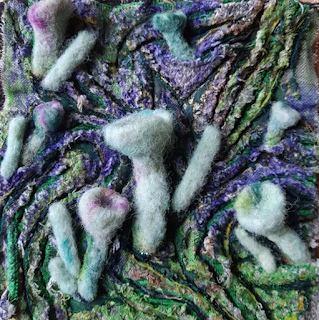
For those of us who were attending this retreat for the first time, we needed to see all that was on offer, and to then be able to decide what to work on. I found for the first 5 days I wasn't focused on creating. Rather I wanted to be immersed in my surroundings as I walked and explored the spectacular views, the magic of the trail, the colourful mushrooms, the discarded and rusted metal implements, even the frog and spider webs at the beach.

I came across a quote by Julia Cameron recently (best known as author of The Artist Way) in her book, The Vein of Gold:

"We speak of "food for thought" but seldom realize that as artists we need thought for food. Walking, with its constant inflow of new images, gives us new thoughts that nourish us. It replenishes our overtapped creative well and gives us a sense of ... well, wellness." 

Very true, I think, and especially important on this trip.

And of course spending time with the other artists and the CPAWS staff talking, getting to know each other, learning about each other's art, bonding were an important part of our process. Meal times, doing dishes, power naps, cooling off in the lake were also a big part of our day, as well as time around the campfire to catch up and share, before retiring to our tents for much needed sleep in preparation for the following day.

While I did get 3 art pieces started, my focus was on capturing (over 350) photos on my camera and making thumbnail sketches and notes about my impressions, materials I could use, colours and textures, even an embellishment technique or two. All this has helped me sort out what I want my focus to be as a result of this experience.

I've now identified 15 or 16 possible pictures to make. The 3 pieces started at the camp are now finished. And I have begun the step in the creative process of gathering materials for a the next 2 or 3.

If I do go back to this retreat next year - and right now I think I'd like to - I'll have a clearer focus of what to work on. And I may be able to pare down my creative process while I'm there. 

As a final note, there were 2 books several of us found to be of great benefit in helping us identify many of the plant life in the area: Edible and Medicinal Plants of Canada and Mushrooms of Ontario and Eastern Canada. I already had one, and now own both.


Related Posts:


ART FROM THE ART RETREAT + SUN PRINTING LEARNINGS

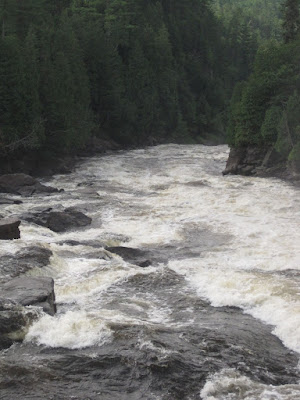
One of my goals at the DRAW (Dumoine River Art for Wilderness Retreat) was to experiment more with sun printing - but before I get to that I wanted to share one of the pieces I finished this week based on a portion of rock canyon wall along the rapids of the Dumoine River and the reference photo I have been working from. 


This has 5 layers of fabric (upholstery material, organza, tulle, cotton, and felt) sewn together, then slashed, working as an ensemble. The slashed parts represent the crevices in the rocks, other areas are cut back to reveal the variation of rock colours and erosion. I added modified French knots to intensify the crevices and build contrast, and French knots in green where plants were thriving on this rock wall. A small sparkly stone also made its way into this art piece, and a hint of metallic gray and white paints to further enhance some areas of the rocks. 

I have several more pieces planned using similar layering and embellishing techniques, based on these photographs from the trip (and more not pictured here):


But now, on to the sun printing and what I learned:

  • I've been working mostly on mineral paper (paper made from rocks by Yasutomo Inc.), quickly becoming my favourite background to print on with good results so far. I have also been experimenting with old cotton fabric, birch bark, and Yupo paper.
  • My experiments with birch bark prior to the retreat worked out well, but not so well at camp. Both times I soaked the bark in water for an hour. The difference is that at home I ironed the pieces between layers of parchment which stopped the edges from curling and the paint from pooling. At camp, although I tried clamping the bark to a backing board using clothespins, it still insisted on keeping its curls and waves. 
Birch leaves on birch bark
  • With some very hot weather at camp, my painted fabrics and bark dried too quickly and I did not have a spray bottle with me to mist the materials. Some of the prints failed, others were not as bright as expected. The mineral paper however seemed to march to the beat of its own drummer: even though the paper appeared dry, upon lifting the leaves I discovered a fair bit of liquid remaining, drying only after removal of the leaves.  
  • Fern fronds, maple leaves and sumac leaves have consistently worked well on all the surfaces I tried. Others I tested at camp included milkweed, birch, sweet woodruff, and sweet fern, with only the sweet fern giving good results. Thin and freshly cut leaves really do seem to adhere the best on the background. At some point I will test ironed and frozen leaves too. 
  • Natural inks yielded interesting results, especially on Yupo paper. I wasn't pleased with the ink on the birch bark, so overprinted with paint after returning home. Good to know this option can work. 
Printed using a natural ink, then overprinted with soft body paint and fresh leaves
 
Indigo ink on Yupo paper


Related Posts:


AN ARTIST RETREAT REFILLS MY CREATIVE BUCKET

I have returned home inspired from a week in the wilderness with a group of like-minded, nature loving artists. Waterfalls, lichens, mushrooms, loons, rocks, hikes, swims, time spent creating and capturing the scenery on canvas or camera. A beautiful environment to explore ideas, experiment and create, in a very supportive environment. 

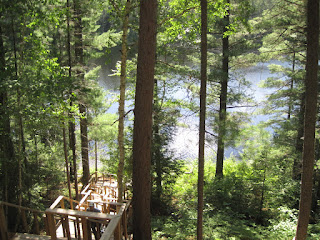
Lac Penniseault
It was a week of inspiring the senses: not just plants and landscapes, but also patterns and reflections; the sounds of loons and their babies, the roaring of the rapids, tent zippers, crackling campfire; the scents of clear air and pine trees; the feel of sand and rocks underfoot and of cooling off in the lake; the taste of local spring water, supper cooked over the fire.

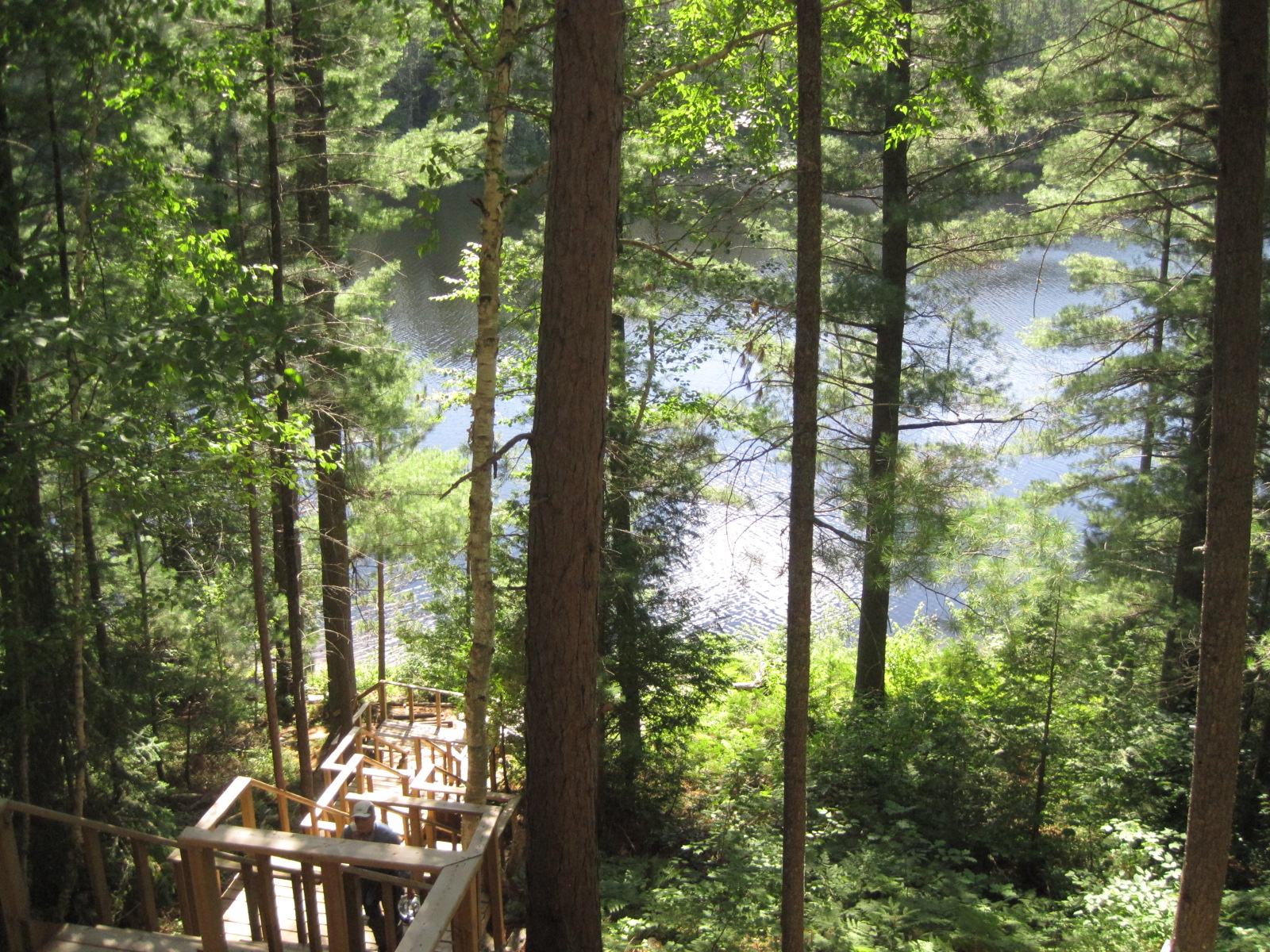
Lac Penniseault - view from the camp

We were 15 artists, spending a total of 7 days together camping in the wilderness of Quebec, thanks to our sponsor, CPAWS (Canada Parks and Wilderness, Ottawa Valley Chapter), at their 5th artist residency, Dumoine River Art for Wilderness Retreat (DRAW). We camped in a beautiful setting with a large area for tents, a campfire pit, deck, eating areas, and a beach 66 stairsteps away (and of course 66 back up). A small barn and woods were ours to explore, finding many old rusted garden and cooking implements and scrap metal pieces, some of which we removed in an effort to clean up the area, but also inspired by the potential of these relics for our own artistic creations. Our disciplines included painters, photographers, a felter, fibre artist, a sculptor, even a sound artist.  

The highlight was visits to the Grand Chutes along the Dumoine River, with its roaring rapids, rocks, and towering trees. The trail along the river offered up a surprising number and variety of lichens, mosses and mushrooms. The feel of the area was magical, leaving us wondering if this was the world in which faeries live. The Dumoine is a protected wilderness area in the province of Quebec, and one which needs to be protected from further climate change and biodiversity loss. 

Dumoine River

Trail along the Dumoine River. Could faeries live here?

I have well over 350 photographs from this trip, including an excursion we took up a mountain where a new hiking trail is being forged, and of wildlife and an abandoned building nearby. We fortunately did not see any bears or wolves or moose.

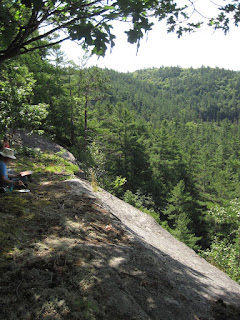
Blueberry Mountain
I have lots of plans in my head for making fibre art pictures from this adventure, including 3 I started during the trip. I was also able to spend time experimenting with more sun printing on fabric, paper and birch bark, testing leaves I had not tried before with varying results. These too will somehow get incorporated into art. I was delighted when some of the artists asked to learn this technique - below is a shirt one artist decided to print on - a synthetic material that actually turned out quite well.
Sun Printing

Sun Printing on Birch Bark
My idea bucket is now very full. I am inspired. We had time to create, time together inspiring and sharing, also time alone to reflect, think, journal and work on our art. And each of us will be creating and donating a piece of art based on the area to help raise awareness of the importance of protecting our parks and wilderness areas.


TYVEK EXPERIMENTS FOR 2026

Although I'm not a quilter, I am a fibre artist and do a lot of machine sewing, mostly random, improvised lines and some free motion. My...