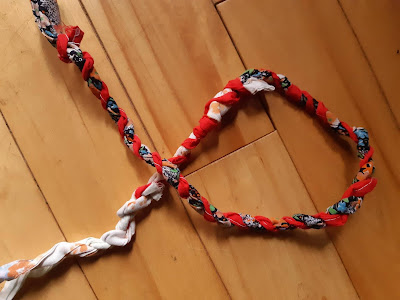
Assemblage art is defined by the Tate Art Museum as "art that is made by assembling disparate elements – often everyday objects – scavenged by the artist or bought specially."
Found art, according to the Tate - "A found object is a natural or man-made object, or fragment of an object, that is found (or sometimes bought) by an artist and kept because of some intrinsic interest the artist sees in it."
There are all kinds of examples of these art forms dating back for many years. Pablo Picasso for example was a creator of assembly art. What I like about these art styles is the scavenging for objects, often keeping them out of landfill when they no longer serve a purpose or have broken down, or repurposing them when coming across intriguing finds at a flea market or secondhand shop into something we can create.
As a fibre artist, I like to include non-textile items in my art pieces when it is appropriate to do so. After cleaning out my mother's old photo albums, for example, I repurposed the photos I didn't keep into painted backgrounds for stitching to make cards. Old cedar planks have become the backgrounds for other art. I've upcycled an old floor grate into a picture frame, and featured a backplate of a door knob in another artwork, surrounding it with more traditional fibre materials.
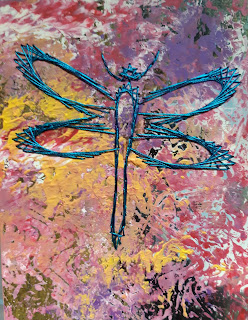 |
| Old photograph with acrylic paint added, then stitched |
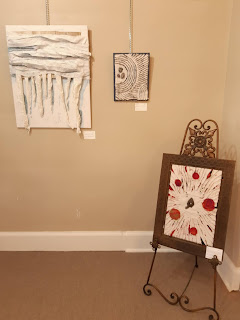 |
| The icicles picture at the far left includes cedar planks in the background. The picture on the stand is framed with an old floor grate, and has a doorknob backplate in the middle as it's anchor to build around. |
October 19th is Textile Tuesday – one of 5 themed days of Waste Reduction Week in Canada.
Lots of information is available online about the amount of textile
waste that goes into landfill, the carbon impact of creating fabrics, how often we
keep and wear clothing pieces, the role of plastics in textiles, and so on. And
while lots of clothing is donated to thrift shops, not all textiles can be
re-sold, some making their way to becoming rags but much more going into landfill.
Information on these and more is on the Waste Reduction Week website at Textiles Tuesday |
Waste Reduction Week in Canada (wrwcanada.com).

As a fibre artist, I’m tickled pink when we share leftover fabric and other various goods and when I'm offered used items. Sometimes this includes materials we may not have experimented with or incorporated into our art previously, leading to some wonderful play and new ideas.
What can we do to reduce textile - and other - waste?
Swap – As the saying goes, one person’s trash
is another person’s treasure. I was recently gifted 3 pairs of jeans that were
torn and no longer worn by their owners, which I’ve since started cutting up
for a couple of projects. There is something appealing about deconstructing old
clothing to use for a new purpose.
A group in my neighbourhood has held 2 clothing swaps of men’s,
women’s and children’s clothing as well as bags and accessories. All clothing
must be clean and in good condition. Clothing is free for the taking, with leftovers
donated to Dress For Success.
Mend or Refashion or Repurpose
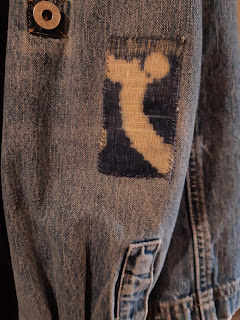
I spent the first lockdown last year learning to mend – repairing several shirts that had small holes and a jean jacket with worn elbows and cuffs – some with stitching, others by adding patches for a more artistic flair. I’m delighted with how they turned out and how this simple repair has extended the life of these pieces.
A favourite was repurposing an old burlap bag into a backing for
hanging jewellery in a picture frame (see post on this project).
And, as mentioned above, I've used bits & pieces of non-fibre and non-textile materials in my fibre art.
Play and Experiment
Old fabrics are wonderful to experiment with: eco-printing, painting,
fabric collage, re-purposing into patches, making fabric twine, rusting with old tools, practicing
free motion stitching. And figuring out what non-fibre objects could be added, or using fibre techniques with alternative materials.
My experimenting today was a piece of assemblage art I started this week: colourful maple leaves, paints and natural inks, and using printmaking techniques to add a subtle background of leaves to a cedar plank.
When was the last time you tried making art from repurposed materials and objects?