Showing posts with label art shows. Show all posts

FINDING INSPIRATION FOR ART

It's been wonderful being able to visit art shows again in person, to actually see the art and not just on a computer screen, to talk to the artists. I like to take photos of art too (with permission of course), especially when I'm inspired by a piece, or when there is a colour combination or perhaps a technique that could be a potential solution to a struggle or two with art that I'm currently making. 

A couple of these shows took me to small towns not far from home. We like to take long walks around places we visit, poking in shops in downtown areas, visiting waterfronts, finding interesting details on buildings and even alleys that invite one to explore. I find so much inspiration and can't help but take more photos, all becoming great references for future. Here are a few from a recent trip that will more than likely be turned into some kind of art:

The striking colour of the orange lichen against
the dark colour, rust, 
and discoloration on a steel bridge:


An old, abandoned factory - there is a kind of beauty in this decay, and I'm already planning a piece from these photos:


I just had to get these 2 photos - a quote painted on a wall on the main street, and a mural made entirely of handpainted small squares, each with a different picture, then assembled into the the larger mural. How inspiring - and creative - are these:


I'm also finding much inspiration during nature hikes. I had joined a snowshoeing and hiking group this past winter, discovering trails in my area that I had not visited before and some I had but had not thoroughly explored. And while I joined primarily for the exercise, I'm thoroughly enjoying the social side and being inspired by the beauty around us during these nature treks, I take photos when I can during these hikes, and have even revisited a couple of places to take more as these photos are providing wonderful inspiration for new art pieces. 

Where do you find your inspiration for new art, or for other creative ventures?


CONVERSATIONS - AN UPCOMING GROUP SHOW

Fibre 15, a local fibre arts group I am part of, is preparing for an upcoming gallery show - we've called it Conversations, and described as:


What is a conversation?
Employing a diversity of fibre media, Fibre15 members explore this theme, challenging assumptions about how and what we exchange.


There are 10 of us in this group show being held June 4-26, 2022, with the vernissage on Friday, June 3rd from 6-8 pm, at the Stone School Gallery run by Art Pontiac, at 28 Rue Mill, Portage-du-Fort, Quebec. The gallery is open Thursdays through Sundays from 11 am to 4 pm.

The support from the gallery has been superb as we get ready for this show. Even though I have an events management background, I'm always surprised just how much work and detail shows such as this can take: 

  • agreeing on the theme
  • preparing the proposal and photographs for our application 
  • taking photos of works for the poster (poster was made by the gallery)
  • deciding who brings what food for the vernissage
  • organizing who will work at the gallery which day
  • writing and collecting artist statements and bios
  • preparing price tags and labels for all the art
  • promotion - through social media, video, etc. - and collecting photos and words for this purpose
  • preparation for set-up, and take-down - and who will collect and deliver the works to the gallery - and the set-up day

Of course, someone really needs to be the lead on this whole effort, to ensure no tasks are overlooked, communicating with the gallery, getting answers to questions.

All this while we still had to find time to make our art. That, after all, is what the show is about - our art and the theme.

I have six works ready (4 are pictured below), but am not yet sure which of the six will actually be in the show. A curating team has been assembled who will make the final decisions around space, cohesiveness etc. 


And three of us also applied to teach during this show - I will be teaching collage & embroidery on paper. Here is the same piece - there is more information on the Art Pontiac website at https://artpontiac.com/en/category/course-2022/

Hope to see you at the show!


12 OBJECTIVES WHEN PARTICIPATING IN ART OR VENDOR SHOWS


I first published in this post in September 2018, then again in March 2019. After two years of Covid-19 and with some shows opening up again, this seems like a good time to re-post. While many shows have gone virtual and some are still virtual, most of the objectives listed below still apply. 


Let's talk about goals & objectives for participating in vendor, craft & art shows. Of course making sales is usually the goal in such shows. We have, after all, spent time planning, gathering supplies, making our products, and we've likely paid a fee to be in the event. We want to move some of our products and make some money from it.

But what if you don't reach your sales goal? And worse, what if you don't make any sales or even sell enough to cover your booth fee? It's happened to all of us at one time or another. Frustrating isn't it! And it's easy to become a grumpy cat during the show, but then potential customers don't want to approach us. And sadly we can start to appear desperate.


But, wait! There are many other benefits to participating in a show. A simple shift can make all the difference in your perception of success, even when your sales goal is not reached. And that shift is to be open to the many other positive gains we can make, positives that can help us down the road. And that shift is to look at the event, not just to make sales, but as an advertising opportunity. So bear this and the 12 ideas below in mind when you're at a show, perhaps even set some additional objectives when working at shows. Great sales or not, these are areas we should be looking at anyway to help us in future. 


        Connect with your visitors

  1. Get your name out there - talk to visitors, make an impact so they will remember you. Connect with them. Shows are, after all, an opportunity to advertise and not just sell. They may not have met you or seen your work before. Or perhaps they are just not yet ready to buy and need more time. And once a potential customer has seen your work, they may look for you at other shows or at the same show next year. 
  2. Grow your client base. Do you send out a newsletter, have a blog, Facebook or Instagram account? Capture names and emails to bring people to your social media accounts (always respecting spam laws of course).
  3. Find out what people think about your work and products. This is a perfect opportunity to get feedback. Show visitors who are attracted to your work will tell you what they like about it, what they look for. You can get a feel if people are looking for functional items, are re-decorating, want inspiration and information, are interested in taking workshops, or are at the show for other reasons. Which item draws them in the most, which one is no one looking at? 
  4. Practice your elevator pitch. Hopefully you will have practiced in advance what to say, and the more you can practice, the easier your words will flow. But don't automatically assume someone wants to hear all about your product if they approach your booth. You need to know what to ask to determine what they may be interested in.
  5. Sign people up for workshops - if you teach, a show is a great opportunity to show what you will be teaching, and get people to sign up to learn the techniques you use.
  6. Try demos. Artists often sit and sketch or paint during quiet times. If you sell kitchenware, demo how to use them. Visitors love to watch and it can help draw them in. Check first that show rules allow demos, as some do not. 

    Network with other sellers
  7. Visit the other artists and vendors, see and talk to them about their work. I often find new ideas  - a different way to display something for example - or am simply inspired and motivated by the artist and their work.
  8. Get leads on other shows and opportunities. Lots of networking can happen at shows, and I've been able to not only book other shows but offer spots to others in shows that I have run. 
  9. Get to know the show organizers to see what else they are involved in.

    Test a booth layout
  10. Test a booth layout or new look or colour. Sometimes it takes a bit of trial and error before we happen upon the ideal set-up to show off our work. And a spot in the middle of the room has to be arranged differently than a corner booth. See what others do that may work for you. Sometimes it's just a little pedestal or some height that can make the difference. And testing outdoor booths is important too, in case of rain or wind.
  11. Take photos of your booth - you'll notice things in the photos that you didn't see in real life, both displays that look great and areas that need to be tweaked. Pictures close-up and farther away can be very telling and can go a long way to helping your booth look polished and professional. 

    Be Inspired
  12. Above all, enjoy. If sales are low, don't be the picture of doom. Visitors can feel your negativity, and may be reluctant to approach you. So no matter how things are going, smile, enjoy and be welcoming. And remember the other ideas above. Who knows what the future holds.
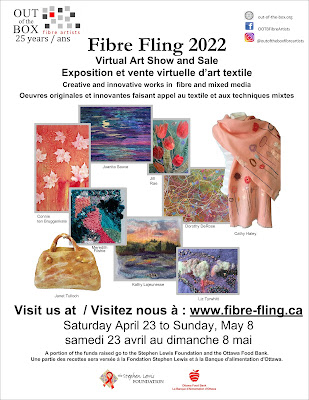
And speaking of virtual, Out of the Box Fibre Artists, of which I am a member, is holding a virtual show & sale April 23, 2022 until May 8th, 2022. Do please check it out! https://fiber-fling.ca/


POST-EVENT BLUES ARE A THING

We spend months planning, preparing, organizing for an art show, wedding or other large event, and are thrilled when the big day comes and see all our hard work come together. We rejoice during the event, taking stock of what worked well, kicking ourselves for what didn't.

And ever so quickly, it's all over. Just like that. Suddenly, just the final paperwork and some clean-up. And reliving the memories.

It's easy for the blues to set in afterwards, after spending so many months planning. You'd think the high would stay, but reality often sets in. It's a rather common phenomenon in fact to feel down afterwards.

You may start wondering what to work on next. In my case I didn't have another project or goal in mind to start preparing for, just a number of small tasks needing done that I had been neglecting. Many don't have a post-event plan as the show may have been a one-time thing. Or we may have simply been looking forward to some well-earned downtime. 

Some rest is needed before embarking on the next project. The fatigue we feel after an event may come as a surprise.  But as day to day normalness sets in, we begin to ponder our next purpose. I have things I should be doing to catch up, you know, some cleaning, weeding the garden, writing some blog posts, a few messes that sorely need re-organizing. But, honestly, I just didn't feel like doing these for a good 10 days or so after my art show opened. And even though I have an idea for a new smallish project, my get up and go seems to have - well - got up and gone. 

So, what can we do to prevent and/or improve these blues? 

  • Be prepared. We know these feelings will likely surface. The right mindset makes a big difference.
  • Recognize that these feelings will pass. We just need a bit of time, and rest. It can last days or weeks but knowing it will end is what's important.
  • Enjoy the memories. If it's the type of event you'll be running again, make notes on what you would change, what you would do differently next time. Savour the areas that worked particularly well. Organize your photographs of the event so you have a good reference for the future. 
  • Review the original goals for your event. Did you meet the goals or do you need to tweak some areas. What are some new goals you can set. See my post on 12 objectives for participating in art shows for some different perspectives.
  • Tap into your social network. Spend time with friends and family. Go out and do some fun activities. Catch up on what others are doing.
  • Spend time in nature. Nature is always healing and helps ground us. Go for long, slow walks, sit by a river or lake, plan a picnic with a significant other. If it's winter, walking, skiing, skating or snowshoeing are good activities.

  • Pay attention to clues and niggles that may become your next project. There's no need to act on anything right away, in fact the recharging time is necessary. Just be aware, note in a journal these types of observations, then after a few weeks see if the ideas have quietly slipped away or if you are starting to see a pattern. When we wait, we'll know if the idea feels right, rather than just rushing headlong into the first idea that comes along.
  • When you're ready, set new goals. Some people know right away what they want to work on. Competitive athletes for example fall into this category. Lots of people need more time though and, as mentioned above, we shouldn't just jump into the next thing without doing a review first.
  • If you continue to feel down, turn to someone for help. Talking it through with a trusted professional can help you work through this kind of difficult time. 

I have a couple of ideas brewing. They are not concrete yet but I'm taking this time to organize some of my messes, look at reference photos, do some research, and experiment with techniques. I'm chomping at the bit to start a new project, but need to remember to be patient so I don't embark on something that's not the right fit.  The recharging of my batteries is so important at this stage. I'll know when I'm ready. 

But first, it's time to review my annual theme or make a new vision board. This may just be the key to taking a step toward my next direction. And I haven't look at my theme since I started on this last project. It's time.

Anne

Related Posts:

12 Objectives when Participating in Art or Vendor shows

Annual Theme? Or Vision Board?


SHOULD VISITORS BE ALLOWED TO TOUCH ART AT ART SHOWS?


Should visitors be allowed to touch art at art shows? I hear a resounding "NO" from many artists out there. The biggest fears seem to be that dirt and natural oils on our hands will transfer to our art or that a piece will get damaged or broken. We want to preserve our artworks after all.

But I also hear a few artists saying "yes" it may be okay to touch art - sometimes, and in a gentle manner.


I had my fibre art lichen at a show recently, not an art show, but as part of a museum's open house. Museums these days are implementing more and more interactive displays, recognizing the public wants more involvement than just looking. People want to touch objects, maybe even hold them, augmenting that participatory feeling.

Fibre art in particular seems to invite people to caress it, even if we don't want them to. It's tactile. It's all about texture. Wools and textiles convey a warmth that reaches out to us.  People want to stroke its softness, pet it like they would a cat or dog. They want to interact with art - whether sculpture, paintings, fibre, paper, pottery or another artform - and especially when a piece stirs up emotions. They build a connection through touch.

I had no doubt lots of people would touch my fibre art at the museum's open house. Especially children, as the sense of touch is very much part of their development. They just reach out and feel it, sometimes gently, sometimes more roughly. And while I didn't want to say no to them, as I understand this need, I did want to make sure they understood they had to be gentle.

Most of the parents asked permission first. Several stopped their children when they saw those little hands reaching. Other times the parents touched without asking, their children following suit. That I believe is inappropriate, parents should set an example by asking first. Granted, I didn't put out a sign saying "Do Not Touch" or "Ask Before you Touch" but perhaps it's because I'm aware the protocol is to ask and not just assume touching is acceptable.

Many people rely on their sense of touch to interpret an object - for them touch, not sight, provides information about the object's properties. Looking at something that appears smooth and shiny isn't enough, it's the fingers resting on or stroking the object that confirms what it feels like: hard, maybe slippery, cool or cold. We learn from a very young age the exploratory powers of touch.

A potter I know provided a textured bowl at shows that one could run their hands over, relieving parents of anxiety about their child - or themselves - touching and breaking, and satisfying a sense of curiosity. What a great solution. And of course for anyone who is visually impaired, well, touch is of course very important.

Maybe us fibre artists need to consider alternatives to satisfy those who wish to touch, to provide a sensory experience that goes beyond just sight. A "look but don't touch" expectation doesn't always work. After all, we fibre artists understand all too well the attraction to tactile objects to make our art, and yet we expect the public to keep their hands off the finished pieces. 

Yes, art shows are primarily visual, but perhaps having some raw materials on hand, or tools used to make the art, or a few pieces of art in a "hands-on" area would satisfy those itching to poke and prod. Then the "Please Do Not Touch" signs can be posted in the other areas. We'll never be able to eliminate touching completely no matter how hard we try.

And while we're on the subject, why not think more about how to reach all the senses, not just sight and touch, and create a truly multi-sensory art show.


ART AS A LEARNING TOOL - AT THE CREATIVE REACTIONS SHOW

My experience as an artist at shows is that some people will stop and look at your work and others will keep walking until they see something that catches their eye. And some will back away if you happen to catch their eye or say hello, wanting to be left alone, not feel pressured to make a purchase. 

But at the Creative Reactions show where I displayed my lichens fibre art piece this past weekend, every visitor stopped to look at every piece of art and spent time speaking with the artists and researchers too. The closest I had come to experiencing this is at fibre art shows where each work includes not only a list of materials and techniques, but also the artist's inspiration. Viewers do seem to take their time looking at each picture when some context is provided. 

The visitors at Creative Reactions wanted to learn the stories behind the art. And each picture had a story to tell. Each artist had been paired with a research scientist to learn about their area of expertise, then create a piece of art based on the researcher's work. The idea was to combine visual art with science, to use the art to create awareness, for education, as a method of learning.

Art often has a hidden depth which a viewer may miss at first glance, and without tips such a materials list or inspiration. We first observe the design, colours, and possibly materials and techniques. The next layer includes messages for the viewers. At the Creative Reactions show the messages were the story the researcher hoped would be told through the art. These messages may or may not be readily apparent until one studies the art more closely and depending on the artist's interpretation of the messages into symbols. Underlying the appearance and messages in the art is yet another layer - the emotional side, a reflection of the researcher's passion for a topic, the presentation of concepts for further consideration by the viewer. These are sometimes subtle yet reflected through the many creative decisions made for each piece of art by the artist. 

It's this kind of attention to detail and love of creating that enriches an art piece. The one I created, titled "Learning about Lichens" includes 5 Canadian lichens, and because Paul, the botanist I was paired with, specializes in Arctic plants, 3 of the 5 are Arctic lichens, 1 of which is very rare and therefore meaningful to the botanists. The remaining 2 lichens were no less important, one selected for its name, the other because of a cross-Canada project the lichenologists had embarked on. 

The background for each lichen was just as important as the lichen themselves to illustrate their habitats, with materials and techniques chosen carefully. And the backdrop for the entire piece was a map of Canada on which the lichens were arranged so the names of 2 of the territories were highly visible. The last feature to be added was labels for each of the 5 lichens, styled after the labels the botanists  use to identify the botanical specimens at the Museum of Nature's Herbarium, and on which I included why the lichen was chosen, and the materials and techniques used to create it.


I realized quickly at this show just how much the viewers wanted to learn and talk about each piece of art and its story. I found there was an equal amount of interest in both the research topic and the materials and techniques I used in my work. And I'm glad I had a chance to see and learn about the other works on cancer therapies, robotics, probiotics and stress hormones, fibre optics, evolution and biodiversity, and ADHD.

Did any of the works sell? I don't think so, although some were for sale. But that wasn't the point or the goal for any of the artists. This was a different kind of show, a chance to expand our horizons, to learn about the research areas, and to see potential for future. 

The team I worked with from the Museum of Nature - Paul Sokoloff, Cassandra Robillard, Chris Deduke, and Troy McMullin - shared their knowledge with me, ideas and support, through a tour and several follow-up emails. I felt like one of the team.

And now that my awareness and knowledge of lichens has grown, I find myself keeping an eye out for them, and even found a lichen in my yard. I had seen it in the past but hadn't given it a second thought until now. I'll need to create that one next in fibre art.

Will I apply for this show again in future? You bet. In the meantime one of the botanists has challenged me to create a fibre art from a specific moss.  Can't wait to get started on this one.

Links to previous posts on my journey preparing for the Creative Reactions show:

Art Meets Science: A collaboration between artists and researchers

Lichens: Fascinating, beautiful and part of an upcoming art show

LICHENS: FASCINATING, BEAUTIFUL & PART OF AN UPCOMING ART SHOW


In my previous post I wrote about the upcoming Creative Reactions art show, for which I have been creating fibre art lichens based on a collaboration with botanist Paul Sokoloff of the Museum of Nature and 3 experts Paul invited to provide input and feedback. The group of 4 botanists and lichenologists is pictured below. 

L-R Cassandra Robillard, Paul Sokoloff, Chris Deduke, and Troy McMullin


A goal for me was to create much texture and dimension in these fibre art lichens, bearing in mind it would be mounted on a canvas and displayed on an easel. During a recent Show & Tell with the Out of the Box Fibre Artists, I presented 4 of the 5 lichens I was working on - in various stages of completion - and was pleased at their interest, feedback and that they wanted to know when and where the show is. I've included some photos below but the photos don't do the lichens justice, so you'll have to come to the show on May 25 to see them in person, and to see the final art piece.

Elegant Sunburst

This lichen got my interest right away due to its striking beauty and the contrast of its orange colour against a gray background.

It seems this lichen feeds on the nutrients left by birds, and so is found in areas where there are lots of birds. And also explains the gray background colour.

I created this background on a brown paper bag, painted and scraped it with modelling paste and sand resin. To add more texture and dimension, I cut up an old tatted doily, painted it with the same gray colours, scrunched and stitched it to the painted bag.

From this doily 


To this painted and scrunched piece, and stitched to painted background

I discovered in my stash of materials a wonderful playful orange yarn, which very closely matches this orange elegant sunburst lichen. My final piece has 3 of these orange lichens on the background; the photo below shows just one section. The "leaf-like" part of this lichen swells when wet, which would be the case in the one shown here.

Elegant Sunburst


Fairy Puke Lichen

What can I say? This lichen was chosen because of its name - fairy puke - and it's brought a smile so far to everyone who has heard the name. Judging by the number of people who remembered this afterwards, they have proved that art can be used for learning. And if you try to picture what fairy puke may look like....

Since some of the reference photos shows this lichen growing on wood, I kept my eye out for some scrap wood, and found some fabulous pieces that a local handmade furniture store makes available to the public.

For the lichen, needle felted small pink over green wool "puke" balls seemed most appropriate, sort of randomly glued as if they had landed on a piece of wood.


Blue Felt Lichen

A third lichen - blue felt - was selected because of a project in which provinces had been invited to name a provincial lichen, similar to naming a provincial flower. Lichenologist Troy McMullin and researchers across the country have been leading this effort to create more awareness about lichens.

Narrowing down the choice could not be easy in each province. While I'm not sure if all have picked a lichen, I did want to highlight this project and chose Nova Scotia's recently named provincial lichen, called blue felt.

Creating this one in fibre art was challenging and it took a few starts and stops before I was happy with it.

I had played with some fabric cut-outs to create the shape and ripples, but none were to my satisfaction. Finding the right colour also proved to be a challenge. Then I recalled a piece of cotton I had indigo dyed last summer (it also has some rust marks) (see photo at right), cut circles from the dyed fabric and basted a hem which I pulled tighter to create the ripples. (Indigo dyeing is a thousand year old procedure using the indigo plant and used today to dye blue jeans as well as for tie-dyeing.)
                                                                                                     

Once I was happy with these shapes, I dry-brushed blue paint onto the surface to tone down the rust colour, and needle-felted blue and grey wool onto the fabric to tone down the rust even further and to add more depth and a felt-look texture. More blue paint was added to the edges of each lichen, then needle felted berries in shades of green and red added.

The completed pieces were glued onto one of the pieces of wood I had salvaged as this lichen is often found growing on the trunks of old trees. While not exact by any means, I'm quite pleased with the final look.


Alpine Bloodspot

The fourth lichen in this fibre art piece, alpine bloodspot, was chosen for its smooth texture and its colours, and because its an Arctic lichen.

For the background I again used brown paper bag, painted with acrylic paints and sand resin. This time I also added used coffee grounds to add a deep brown soil-like colour.  My husband had offered me some potting soil to use but as fibre artists will tell you, coffee grounds look more like soil than soil does!


With the background complete I began working on the bloodspot lichens. The red and white bits were made from polymer clay and sanded to smooth the rough edges. The white fabric background is strips from an old wool blanket, and rug-hooked onto an open weave fabric which added much dimension to the piece. I had first toyed with other off-white fabrics, but none came close to the texture I got from this blanket.


Arctic Orangebush Lichen

This last lichen took longer to choose. A number of ideas were presented by Paul and his team, but in the end this one became the  choice due in part to its texture, but more importantly because of its importance to those who specialize in Arctic plants. This Arctic orangebush lichen is only known in the western Canadian Arctic and is considered rare. 2017 saw an Arctic expedition in honour of Canada's 150th, here is a link to Paul's posting on finding this rare species during the expedition:
https://canadianmuseumofnature.wordpress.com/2017/12/13/two-rare-species-one-big-trip/

This one also took more experimenting on my part to find both materials and a technique that would work to create something similar. After a few false starts, I went back to the old tatted doily I used for the elegant sunburst lichen, cut more,  painted it yellow and added fabric stiffener. And stitched it to a background of needle felted wool roving. The roving has various sheep and llama wools in earthy colours and I was able to create small hills of "soil" in which this lichen could grow.


Alpine Orangebush Lichen


------

This project for me has been a gift, one that pushed me to create more texture and dimension than I've done before. And it included an educational aspect about the lichens that I don't usually get with the subjects I work on. As I was finishing up these lichens and starting another project, I quickly realized I was already a bit bored with it without the challenge of creating  so much texture. 


I will definitely be keeping an eye out this spring and summer for lichens in the area, and will have my camera in hand to capture their beauty and, hopefully, capture them in fibre art too.

My thanks go out to Paul and his team for all their thoughts and feedback. And to Mirka Strmiskova for selecting me as one of the eight artists, and for organizing the Creative Reactions show. I can't wait to see what the other projects are and meet the experts behind them.

Again, the show Creative Reactions is Saturday, May 25 from 6:30 - 9:30 pm at the Plant Recreation Centre at 930 Somerset Street West. 


ART MEETS SCIENCE: A COLLABORATION BETWEEN ARTISTS AND RESEARCHERS

Art meets science in an upcoming show titled Creative Reactions, on May 25th, 2019, at the Plant Recreation Centre in Ottawa. It's a show of art created by artists who were paired up with academic researchers and based on themes such as the human body, galaxies, society, etc. Creative Reactions explores the relationships between art and science, the use of creativity, art as a method for learning, as a means for visual communication. And I'm excited to be one of the eight selected artists.

I was partnered with botanist Paul Sokoloff, senior research assistant with the Museum of Nature, who invited me for a tour in February of the museum's Herbarium in Gatineau which, even though I've lived in Ottawa all my life, I did not know existed.

I was wowed! A building comparable to the size of the new Amazon warehouse, Paul - whose specialty is Arctic botany - treated me to a tour: no end of ferns, mosses, lichens and other plants, plant uses, some history, some Botany 101 and even a peak through a microscope. So many botanical species, old and new, scads of which I had never heard of, but all documented and innumerable added into a searchable database accessible by the public.

One of many photos I took of the samples at the Herbarium

A close-up of the information one of the Herbarium's samples

My visit lasted about 45 minutes and, with my creative well full of ideas to consider for an art piece for this show, my challenge was to narrow down the possibilities, bearing in mind the goals of the program. 

Possible subjects included climate change and its effect on plant habitats, medicinal uses, plants of the Arctic, expeditions, and so much more. But I found I kept coming back to the beautiful and enchanting lichens, a fascinating world I could journey to and learn more about, and one that presented me with so many artistic possibilities to create a piece of art. And lichens, I learned, are actually a combination of fungi and algae. 

As fibre art is all about texture, I knew this would be a good fit. And while I had played in the past with various fibre art techniques and materials covering a variety of subjects, I had never explored the subject of lichens. I knew lots of experimenting would be needed to identify the best options to fabricate the three-dimensional textures of these organisms and the surfaces on which they grow.

As we narrowed the search to select 5 or so lichens, Paul included several lichen experts on the emails to provide their input and thoughts, as we looked at lichen colours, textures, properties, a focus on the Arctic but also other regions of Canada, unusual names, beauty, and projects related to lichens.

The 5 lichens were selected throughout March and April, some I have now completed and some are still in progress for my fibre art piece. All 5 will be mounted onto 1 canvas, and a background designed to provide more information about each. My next couple of posts leading up to the Creative Reactions show on May 25 will cover the 5 lichens, why each was selected, the materials I chose and the techniques. 

In the meantime, here are some links to some of Paul's postings on his own botanical journey and explorations with the Museum of Nature. Some fascinating - and educational - reading:

Adventures in botany, on Earth and Mars
Northern Plants in the Capital: Mer Bleue Bog
Botanist Paul Sokoloff on his journey to the Arctic
The “Martian” Flora: Extreme Life in Extreme Environments

CREATING ART FROM MUSIC

Synaesthesia is defined as:
"a perceptual phenomenon in which stimulation of one sensory or cognitive pathway leads to automatic, involuntary experiences in a second sensory or cognitive pathway."  
Some synesthetes see letters and numbers as colours, others may see days of the week as shapes, some taste sounds, yet others see colours or images in music. Many other combinations exist where the senses are cross-linked or merged. And I've become fascinated with this subject.

I am not a synesthete, but I can discern images from some music, like a sixth or kinesthetic sense. It's more than just listening to the music, it's about feeling its vibration and energy, experiencing emotions and sensations. Music may rouse goosebumps or stimulate muscle tension. Breath rate, blood pressure, pulse and skin temperature may change. We may be compelled to move or dance. Pain relief is a possibility. We experience higher energy or a feeling of relaxation. We may see colours or images or movement.


Receptiveness varies from person to person. Images may come based on genre, chords, melody, rhythm, tempo, instruments, vocals, loudness or softness, high and low pitched sounds. 


After coming across several instances of creating art from music, including learning from a friend with synaethesia that she sees each number as a specific colour, I took a class this past spring through Almonte's Mississippi Valley Textile Museum on colour approaches inspired by the senses (other than sight). Later a local pianist shared that she had an artist painting her music while she played at a recital. The abstract pictures, done in gouache, are stunning! 


After deciding to create some pictures based on pieces of music, I discovered that some songs speak to me, others do not. It's all about being tuned to the music, being mindful and turning off all else while listening. And being open to whatever may come up - difficult or positive. The images are not necessarily realistic, but often a level of abstraction.


I then happened upon an ad about an upcoming show at the Atomic Rooster on Bank Street: Tones is an exhibit of art - not just of creating while music plays in the background - but about creating a work of art inspired by the music. And artists are asked to include a YouTube link so the visitor can listen to the music while viewing the work based on that song. 


     Tones (Art Inspired by Music)

     Dates:                November 27 - December 18, 2018
     Opening party:  Tuesday December 4 from 7-10pm. 
     Location:            Atomic Rooster, 303 Bank Street Ottawa

I hope to enter 2 or 3 fibre art pieces in this show. The one piece I have completed so far, the abstract pictured below, is based on Bitter Sweet Symphony by The Verve. 


The colours came to me first, reflecting both harmony and contrast in the music. After painting the background and choosing fabrics to include, shapes began to form in my mind based on the rhythm and repetitions in the music and on the directions in which it was going.  The next layers represented bits of the melody and chords. It was not really a thought process of creating, but rather done at an intuitive level while listening repeatedly to the song. What a great way to get out of our usual grooves of creation. 

I'm looking forward to seeing Tones at the Atomic Rooster and what other artists are creating. Let me know if you'll be putting in a piece or two or visiting the show. 

TYVEK EXPERIMENTS FOR 2026

Although I'm not a quilter, I am a fibre artist and do a lot of machine sewing, mostly random, improvised lines and some free motion. My...