Showing posts with label beautiful destruction. Show all posts

SUN PRINTS - AND AN UPCOMING ARTIST RESIDENCY

Delighted to announce I will be taking part in a week-long artist residency at the end of July through the Dumoine River Art for Wilderness Retreat, sponsored by the Canadian Parks and Wilderness Ottawa Valley Chapter. The retreat includes 15 or so artists using a variety of mediums from felting to photography to painting to storytelling. We will be creating art en plein air, inspired by the rugged beauty of the area.

The goals of the retreat are to:

  • learn more about conservation, to be inspired by the richness of the area
  • create art that supports CPAWS-OV's conservation work, and
  • raise awareness of the important of parks and protected areas in halting and reversing climate change and biodiversity loss. 

My personal goals at this residency are to:

  • create small fibre art pieces to document parts of the landscape: the lines in nature, decay, tree bark, lichen, rocks, and more 
    • I also plan to do some sketching and take oodles of reference photos to continue this goal later on, plus record my impressions about the land, colours, textures and other thoughts, and 
  • experiment with sun printing on fabric and paper. We won't have electricity at this retreat, so steaming my fabric to eco print won't be an option. Instead I'll use the power of the sun. 

In preparation for sun printing at the retreat, I googled this topic looking for information such as which paints and materials work best, since I can bring only a limited amount of supplies. I found only a handful of blogs where the writers have experimented beyond the basics. Cotton fabric was highly recommended, and 2 types of paints: Pebeo setacolor for light fabrics (a transparent paint) and Liquitex soft body acrylics. Some also recommended using mordants such as alum or rust. 

Here is what I have tried so far as I began experimenting prior to the retreat start:

  • White cotton and cotton rag paper: I treated both with alum in advance, then painted  with Setacolor paints. The fern leaves have good contact with the paper and fabric, helping to ensure sharper edges in the final print. I left these to dry for about 2 hours. 


Below is the result on the cotton fabric - this was on an old, embroidered cloth:


This was the result on cotton rag paper, much more subtle, yet I do quite like the effect:


  • Next I tried a scrap from an old yellow cotton sheet, putting it into a rust mordant first, then painting it with the Liquitex soft body acrylics. I  am very very pleased with the result:

  • Old linen, treated first in a rust mordant, turned out beautifully using red and orange Liquitex paints:


  • Rice paper, painted with the Liquitex soft body paints. I had no idea how this would turn out. It's subtle, yet soft looking, and I think has wonderful potential as a background or perhaps with some stitching added: 


  • Yupo paper was next on my list to try, and is my favourite so far. Yupo is a synthetic paper, very smooth, and often painted with alcohol inks. For this experiment, I tried Setacolor paint, with surprisingly pleasing results. I love that the veins of the leaf show up, and that the print left a solid line around the leaves. I will definitely experiment with more on this paper and already have a project idea in mind:


  • These next two are on watercolour paper using Setacolor paints, also with interesting effects. I'll be trying this again to see if I get similar results:


So, what's next? 

I've had fun with these experiments - and will try different leaf and plant types to see which will provide good contact with the materials. I also plan to try bleeding tissue paper and printing  on materials such as mineral paper (made from rocks), Tyvek, brown paper bag, old newspaper, and more. I will let you know how they turn out in the next couple of weeks, as I narrow down my supply list for the retreat. I may even try some solar dyeing in mason jars. 
Out of interest, I found a reference to an article in Quilting Arts Magazine, summer 2006, about sun prints on tissue paper. And I just happen to have that issue in my magazine stash.
Stay tuned!

FINDING THE BEAUTY IN DECAY, CORROSION, AND THINGS PAST THEIR PRIME

Every once in a while we chance upon art that leaves us awestruck. A jaw-dropping calendar of photographs I received in 2015 had imprinted on me the beauty that can be found in this world - and the equally staggering destruction of our climate.

The calendar was created by Louis Helbig, based on aerial photographs from his book Beautiful Destruction, of the Alberta oil/tar sands, and the messages he conveys through his medium and the guest excerpts by several well-known personalities.

This calendar still hangs in my studio, 7 years later, so struck was I by his work: the patterns captured from the air, the expressive perspectives, the barrenness of the landscapes. My hope was that one day I too could capture such beauty in my art, developing my own artistic eye to see these unusual lines, forms, movement and patterns.

While my focus may not be about climate change (although it is a meaningful and important topic), I have begun in the last few years to capture the lines we find around us, both natural and manmade, and often altered or corroded by the elements. My Lineations series has been all about these lines. 

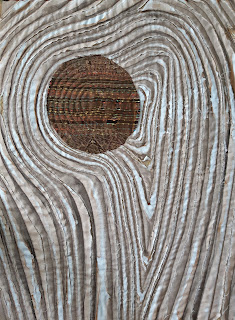
Tree Rings

I like to photograph these elements close-up, capturing snippets and affected areas that have rusted, corroded, decayed, weathered. The Japanese philosophy, Wabi-sabi is all about the beauty of things imperfect, impermanent, and incomplete, and plays a part in my art these days. This concept has given me a unique perspective as I look at the world around me. I now see with new eyes the beauty in rust, a flower past its prime, peeling paint, crumbling stone, the wrinkles in aging hands.

During a hike on a local trail last month, we happened upon a number of abandoned and rusted items - farm equipment, cars, a stove, fridge, tools - seemingly left behind on what used to be a farm in the 1950s. I likened these discards to outdoor art - and took many photos -  suggestive of ideas for my own future fibre art.


A few years ago I embroidered a series on hands - the aging hands of four women over the age of 80 - along with a small biography on each of the very creative women I picked. I'm still fascinated with hands, as there is so much history, wisdom, and experience in their lines and scars. I called this series "Hands of Time".


To represent the timeworn lines of my subject, I like to use the sew 'n slash technique of layering fabrics, then cutting and distressing with agitation and heat, as well as adding embellishments, all revealing the characteristics and secrets hidden below the surface. 

TYVEK EXPERIMENTS FOR 2026

Although I'm not a quilter, I am a fibre artist and do a lot of machine sewing, mostly random, improvised lines and some free motion. My...